
MBA Without CAT in Bangalore 2026: Exams, Colleges and Admission Guide

 By Jai
Both MBA and PGDM are 2 year postgraduate management courses but the main difference between them lies in the type of approving body, institute, and the future career goal. Note that UGC awards MBAs, while AICTE approves PGDMs. For anyone who is looking to work in private sector, a PGDM from a reputed autonomous business school can be a good option due to its industry specific program. On the other hand, if you choose MBA, your chance of getting placed in both government roles, PSUs, and academia increases.
MBA and PGDM are both two -year management courses that appear identical in duration, entrance exams, and future jobs, but the colleges that offer them and the rules they follow are different. Take a look at their differentiating points below-
| Factor | MBA | PGDM |
| Full form | Master of Business Administration | Post Graduate Diploma in Management |
| Programme type | Degree | Diploma (equivalent to degree when AIU-recognised) |
| Governed by | UGC (University Grants Commission) | AICTE (All India Council for Technical Education) |
| Offered by | University-affiliated colleges | Autonomous AICTE-approved institutions |
| Curriculum | University-set syllabus, changes slowly | Institution-designed, updated frequently |
| Admission route | CAT, CMAT, MAT + Karnataka PGCET for govt quota | CAT, CMAT, MAT, XAT, ATMA, GMAT, no PGCET |
| Fees (general range) | Rs. 2-8 Lakhs typically | Rs. 6-15 Lakhs typically |
| PhD eligibility | Yes, directly | Yes, if AIU-recognised institute |
| Government jobs | Eligible | Limited, most PSU notifications specify degree |
The official rules behind these programs matter more than you might think. Because PGDM courses are approved by the AICTE, they are shaped directly by industry experts and can update their subjects from term to term. Traditional university-linked MBAs cannot change their syllabi that quickly. However, UGC-backed MBA programs give you a formal university degree, which is a strict requirement if you are aiming for government sector jobs.
Most articles give vague answers. Students looking up “PGDM vs MBA” get five pages of guessing, just ending in “it depends.” We’ll skip that.
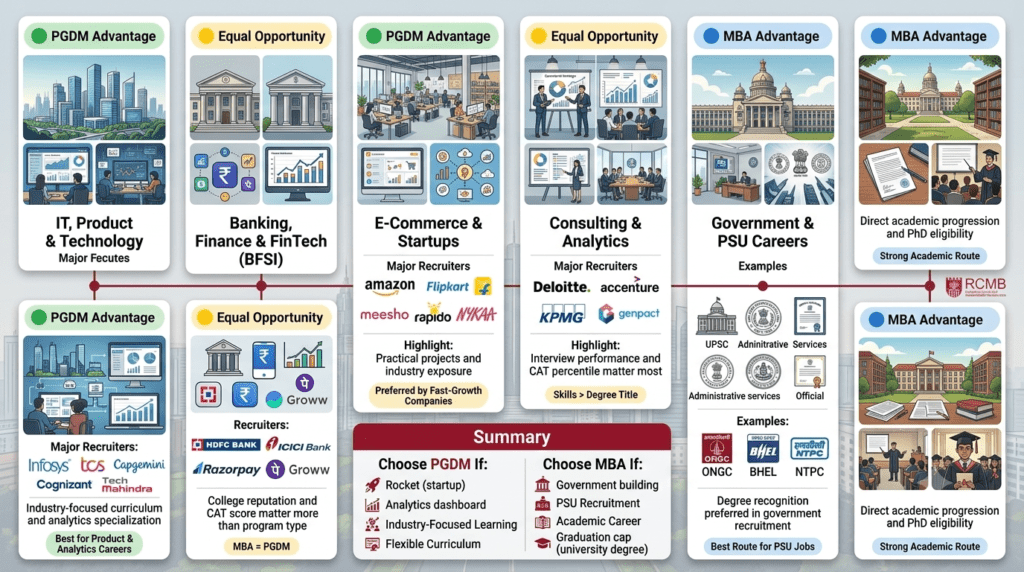
The real answer in 2026 relies on your target industry, not the title. Here is how both paths actually work in specific sectors:
The PGDM vs MBA salary question is probably the first thing students Google when comparing these two programmes. And the honest answer is that the gap at the fresher level, from the same college, is smaller than most comparison articles suggest.
What actually drives salary differences is the college’s placement network, your specialisation, and your interview performance, not the label on your certificate. Choosing the right MBA college in Bangalore often has a greater impact on placement outcomes than choosing between an MBA and a PGDM. That said, here is what the MBA vs PGDM salary picture looks like by sector:
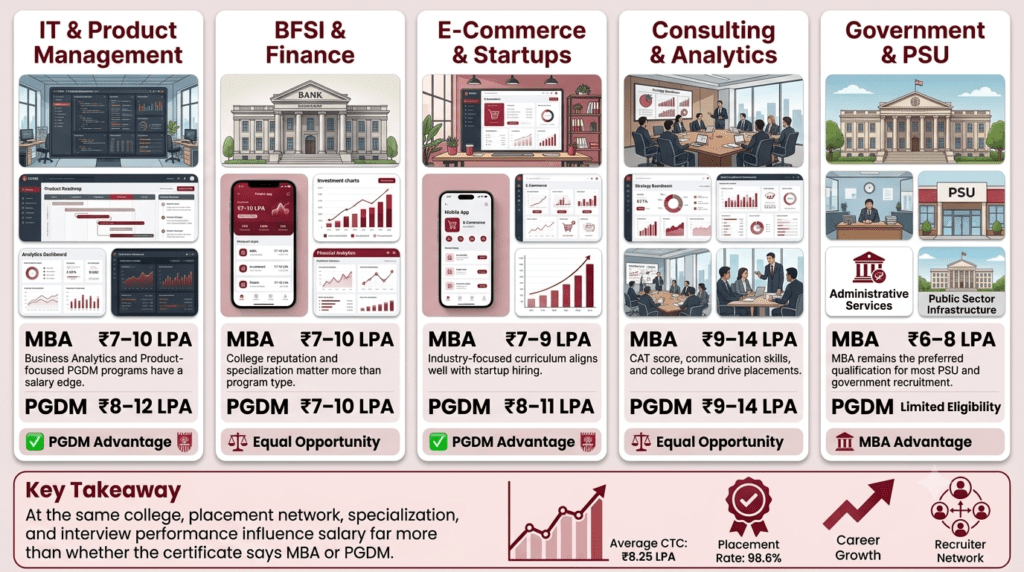
| Sectors | MBA Avg. Fresher CTC | PGDM Avg. Fresher CTC | Notes |
| IT and Product (Analytics focus) | Rs. 7-10 LPA | Rs. 8-12 LPA | PGDM analytics edge at senior entry roles |
| BFSI (Finance specialisation) | Rs. 7-10 LPA | Rs. 7-10 LPA | Equivalent; institution matters more |
| E-commerce and Startups | Rs. 7-9 LPA | Rs. 8-11 LPA | PGDM preferred for agility-first roles |
| Consulting and Analytics firms | Rs. 9-14 LPA | Rs. 9-14 LPA | CAT score drives shortlisting, not programme type |
| FMCG and Marketing | Rs. 7-9 LPA | Rs. 7-9 LPA | Equivalent at fresher level |
| Government and PSU | Rs. 6-8 LPA | Not typically eligible | MBA required for most government recruitment |
RCMB’s 2024-25 placement data shows an average CTC of Rs. 8.25 LPA across both MBA and PGDM batches, with a 98.6% placement rate. Recruiters active in both batches include Accenture, HDFC Bank, TCS, Amazon, Capgemini, PhonePe, Flipkart, and Genpact. For the full salary breakdown by specialisation and year, read the detailed guide on MBA salary in Bangalore. The sector-by-sector numbers are directly relevant to PGDM graduates too.
ROI is the question working professionals ask most. You’re not just choosing a programme. You’re choosing how to spend Rs. 8-15 Lakhs and two years. So let’s do the actual math instead of repeating vague salary ranges.
According to NIRF Management Rankings 2024 (Ministry of Education, India), mid-tier management colleges report average placement packages of Rs. 6-12 LPA. Specialised PGDM programmes in Business Analytics are seeing 20-25% faster salary growth in the first three years compared to general management tracks.
Here’s what the ROI looks like at RCMB specifically, where both programmes carry approximately the same total investment:
| ROI Factor | RCMB MBA | RCMB PGDM |
| Total programme investment | approx. Rs. 8.8 Lakhs | approx. Rs. 8.8 Lakhs |
| Average CTC (2024-25 batch) | Rs. 8.25 LPA | Rs. 8.25 LPA |
| Monthly take-home (estimate) | Rs. 55,000-62,000 | Rs. 55,000-62,000 |
| Fee payback period | approx. 13-14 months of employment | approx. 13-14 months of employment |
| 5-year cumulative earnings | Rs. 55-65 Lakhs (estimate) | Rs. 55-65 Lakhs (estimate) |
| Salary premium vs no PG (5 yrs) | 30-40% higher earnings | 30-40% higher earnings (private sector) |
| PhD or academic career | Eligible directly | Eligible if AIU-recognised |
| Government job eligibility | Yes | Limited; check notification specifically |
If both these management courses belong to the same college and use the exact same placement team, your financial return on investment (ROI) will be pretty much the same.
A real ROI gap only happens if you compare a well-connected PGDM from an independent AICTE school against a university-linked MBA that has poor placement support. In those cases, the PGDM usually wins.
The actual placement history is much more important than the title of the program (whether it is MBA or PGDM). Make sure you always go through the real placement data before making your final choice.
The PGDM vs MBA fees debate is where a lot of students get confused because they’re comparing numbers from completely different college tiers. A government MBA college can cost Rs. 50,000 for the full programme. A premium PGDM from IIM-A runs Rs. 25-30 Lakhs. Those numbers are not comparable.
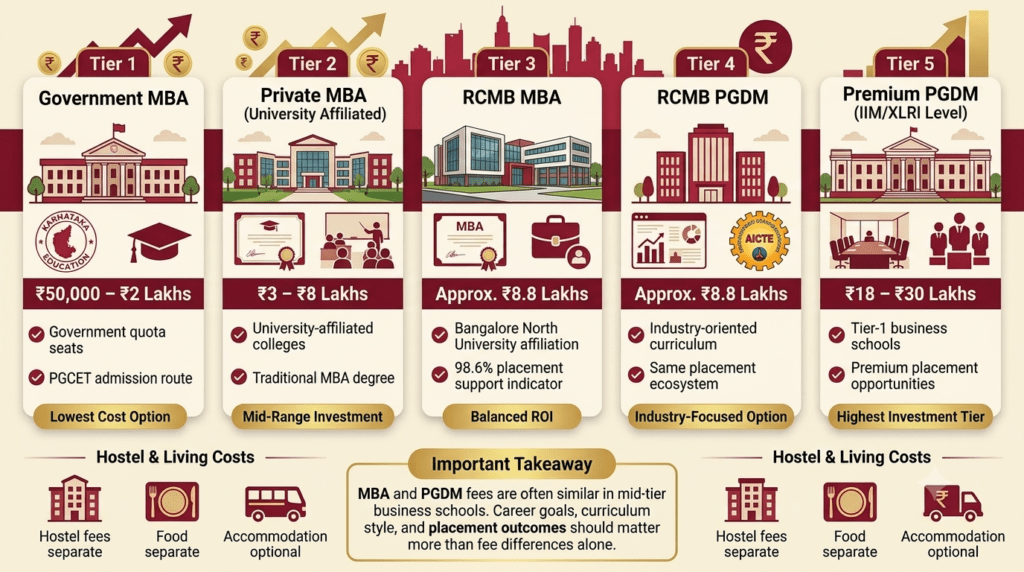
Here is a more useful breakdown of what PGDM vs MBA fees actually look like across different college types:
| Programme Type | Cost breakdown for Full Program | Notes |
| Government MBA (state university- affiliated) | Rs. 50k to 2 Lakhs | PGCET government quota seats; limited availability |
| Private MBA (university-affiliated, mid-tier) | Rs. 3-8 Lakhs | Local private colleges (Bangalore university-affiliated) |
| Private PGDM (autonomous, mid-tier) | Rs. 6-12 Lakhs | AICTE-approved colleges outside IIM tier |
| Premium PGDM (IIM, XLRI, SPJIMR) | Rs. 18-30 Lakhs | Tier-1 autonomous B-schools |
Important points to note:
Bottom line on PGDM vs MBA fees: if budget is your primary constraint, government MBA through PGCET is the most affordable route. If you’re comparing RCMB’s MBA and PGDM specifically, fees are identical and should not be the deciding factor between the two.
If you have any doubts, you can check out separate guides on MBA eligibility and PGDM eligibility to know more about selection process.
The short answer is yes. Generally a PGDM certification is almost equivalent to doing an MBA degree. But on paper, PGDM is a diploma program instead of a degree. For government jobs or PhD, your college needs official approval from both AICTE and AIU to count as an MBA.
The Association of Indian Universities or AIU is the body that upgrades a PGDM into a full Master’s degree. Without this certification, you can get corporate jobs, but you can not apply for PhDs or any government roles.
Note: Verify the management school is both AICTE and AIU-recognized before you apply to any PGDM program
If you want a government job, you can choose MBA. It is a much more straightforward path.
Major public sector companies and exam boards like UPSC, KPSC, ONGC, BHEL, and NTPC generally require an MBA or its equivalent. For a PGDM to count as an equivalent, it must be from an institution that holds formal AIU recognition.
Here the bottom line is – For a primary focus on government service, an MBA is the perfect choice. If you are aiming for a corporate job in any tier 1 cities first and keeping public sector roles as a second choice, an AICTE-approved PGDM will keep both doors unlocked.
If you have already chosen RCMB for MBA/PGDM, you should know that both these programs share exact same campus, teachers, and placement team. Both programmes lead to similar career results: a 98.6% placement rate and an average package of ₹8.25 LPA (through MBA/PGDM program). Here, the main difference lies in how every course is officially structured and updated.
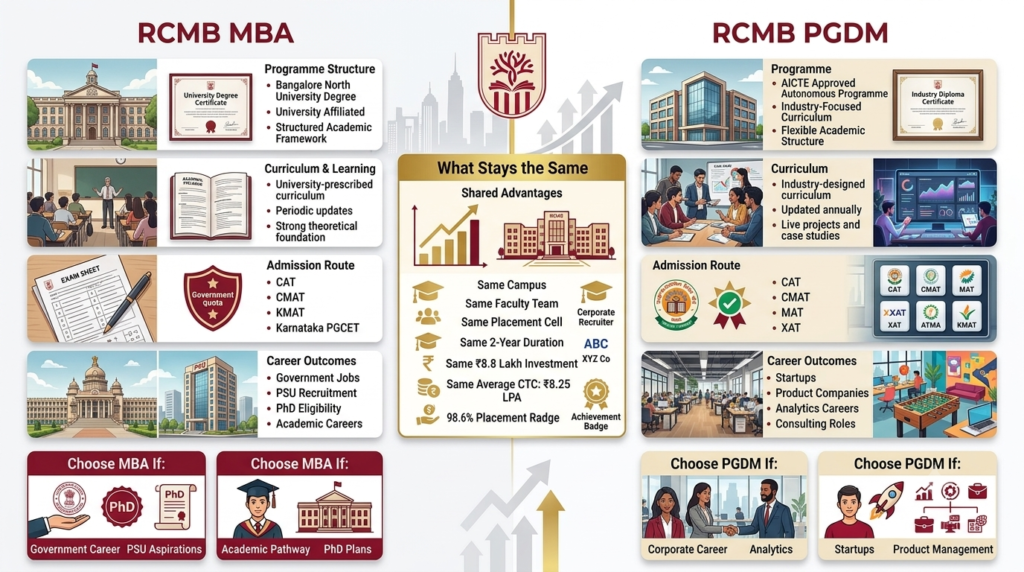
So what actually differs? Quite a bit, once you look at the structure.
| What Differs | RCMB MBA | RCMB PGDM |
| Affiliation | Bangalore North University, university degree | AICTE-approved autonomous, industry diploma |
| Curriculum refresh | University syllabus, updated per BNU schedule | Institution-designed, updated each academic year |
| Admission route | CAT, CMAT, KMAT + Karnataka PGCET for govt quota | CAT, CMAT, MAT, XAT, KMAT, ATMA |
| Government job eligibility | Direct, university degree | Depends on notification and AIU recognition |
| Curriculum flexibility | Structured, follows university framework | More flexible: electives, live projects, case focus |
| Duration | 2 years | 2 years |
| Total investment | approx. Rs. 8.8 Lakhs | approx. Rs. 8.8 Lakhs |
| Average CTC (2024-25) | Rs. 8.25 LPA | Rs. 8.25 LPA |
Also, feel free to explore our RCMB MBA admission and RCMB PGDM admission pages for all the details on classes, career options, and application steps.
Every student should choose management course based on their actual career plans.
For example:
Here are six student profiles with one clear recommendation each:
If you are still figuring out where to live during the programme, you can take a look at the best MBA hostel facilities in Bangalore. This blog can give you a brief idea about the accommodation options, hostel vs PG cost comparison, and transport services.
Value isn’t just the number on your offer letter. If pay was the only measure, MBA and PGDM come out almost even, you’ve already seen that in the ROI numbers above. Real value also depends on how far your recognition stretches, how easily you can change direction later, and whether your syllabus is still relevant by the time you graduate.
So instead of repeating the salary comparison, here’s value broken down the way it should actually be judged.
MBA has the edge here. A university degree keeps every door open, government, PSU, academic, without anyone asking follow-up questions. A PGDM keeps the same doors open too, but only if your specific institute carries AIU recognition. So this point depends heavily on which college you pick, not on the course type itself.
PGDM wins this one. Autonomous AICTE-approved colleges design their own syllabus, which means case studies, electives, and tools get refreshed almost every year. A university-linked MBA moves slower since any change needs formal board approval, so classroom content can sit a year or two behind what companies are actually doing.
This comes down to college tier, not the label on your certificate. At the same institute, RCMB for example, MBA and PGDM cost the same and lead to the same average package, so there’s no value gap at all. It only becomes a real question when you’re comparing two different colleges altogether, a low-cost government MBA seat against a premium PGDM, say.
Here’s the quick summary:
| Value Angle | Winner | Why |
|---|---|---|
| Government or PSU eligibility | MBA | University degree, no conditions attached |
| Curriculum relevance | PGDM | Refreshed yearly by industry-linked institutes |
| Fresher salary (same college) | Tie | Placement network and specialisation matter more |
| Flexibility to pivot mid-programme | PGDM | Electives and live projects, less rigid structure |
| Long-term academic path (PhD, etc.) | MBA (or AIU-recognised PGDM) | Direct eligibility, no extra verification needed |
The Verdict: Neither course is universally more valuable, it depends what you’re protecting against. MBA is the safer call if your plan needs a government-recognised degree with zero exceptions. PGDM is the stronger call if you want a curriculum that keeps pace with what companies are hiring for right now. At RCMB, since both programmes share the same faculty, the same placement team, and the same ₹8.25 LPA average package, the real decision isn’t which one pays more. It’s which door you want to keep open.
MBA and PGDM are not in competition. They’re built for different career paths, and the question of which is better only has a useful answer when it is tied to a specific goal.
In private sector’s, PGDM from a well-placed autonomous institution gives you a curriculum that keeps pace with the market and a recruitment profile that matches what companies like Accenture, PhonePe, and Flipkart actually want.
MBA gives you the university credential that matters for government careers, PSU recruitment, and academic pathways. If those are on your list, MBA is the right call.
If you’re choosing between RCMB’s MBA and RCMB PGDM, the placements, faculty, and campus are identical. The decision comes down to your career direction and your admission route. Both are strong choices with a verified Rs. 8.25 LPA average CTC and a 98.6% placement record behind them.
Ready to apply? Start the process at RCMB. For questions about which programme fits your background, reach out through the RCMB admissions enquiry page. The team can help you work through the PGDM vs MBA decision before you commit.
Freshers from the same college earn almost similar salary packages regardless of the degree name. If you choose Business Analytics for PGDM, it can give you around 20% to 25% raises in Bangalore’s tech and consulting sectors within the first 3 years.
Both MBA and PGDM programs carry equal weight for standard corporate IT roles. If you are targeting roles like analytics or product management, generally PGDM has an edge because its syllabus adapts quickly to new industry tools.
No, PGDM is not a good career option because most government and PSU job notifications specifically require a formal MBA degree. A PGDM will only qualify you if the college has official AIU recognition, and even then, some government agencies strictly demand a degree over a diploma.
Yes, you can absolutely do a PhD, but only if your PGDM college has official AIU recognition. Generally this recognition status can make your diploma equal to a master’s degree. Without this official approval from AIU, universities can block your doctoral admission.
Both are equally competitive for general applicants, depending entirely on the college rank. However, reserved category students will find an MBA easier to get into because it offers special government quota seats through the PGCET exam, which PGDMs don’t have.