MBA Without CAT in Bangalore 2026: Exams, Colleges and Admission Guide

 By Jai
To choose an MBA college, first you need to check your eligibility and then pick entrance exam. Based on your exam scores, you will be selected for institutions. Then you need to verify accreditations of the college and evaluate their placement data. Also, look at faculty quality, curriculum industry integration, alumni network strength, and whether the college location connects you to the industry you want to work in.
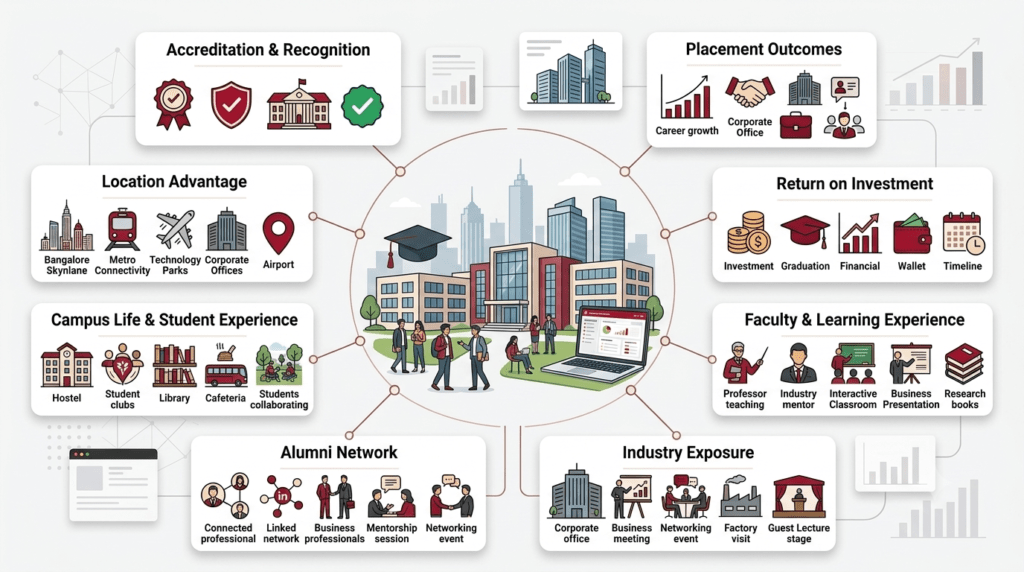
Here is the honest quick-reference version before this guide goes deeper on each factor.
Colleges are graded based on teaching, research, graduation result, inclusivity, and public perception under NIRF Management Rankings 2024. This provides a solid quick guide to overall quality, but it does not guarantee your individual success in your specific target major
| Factor | What to Actually Check | Green Flag | Red Flag |
| NAAC Accreditation | Grade + validity on naac.gov.in directly | A or A+ grade, currently valid | No grade, grade expired, or only shows on brochure |
| AICTE Approval | Verify at aicte-india.org for the current year | Listed as approved, correct intake | Not on list or approval status ‘pending’ |
| Placement record | Median salary, batch size, PPO%, year-on-year trend | Named recruiters, consistent 3-year data | Only highest package mentioned, no batch size shown |
| ROI | Total cost vs average CTC and payback months | Payback under 18 months | High fees, weak CTC, vague placement numbers |
| Faculty | Academic PhDs plus industry practitioners, updated syllabus | Industry experts teaching applied courses | All academics, no industry background at all |
| Curriculum | Case studies, live projects, industry interface programs | Updated annually, industry guest lectures | Same syllabus from 5 years ago, no practitioner involvement |
| Alumni network | LinkedIn alumni search, seniority at 3 and 5 years | Active alumni, accessible for mentorship | No visible alumni presence on LinkedIn |
| Location | Near your target industry in Bangalore | Close to relevant IT, BFSI, or logistics cluster | Far from all major employers with no campus transport |
| Internship structure | Built into curriculum, college-supported | PPOs available, industry partners involved | Students find internships on their own, no college support |
| Campus life | Student clubs, peer diversity, extracurricular engagement | Active clubs, diverse batch, events calendar | No visible student activity outside classrooms |
Before you start comparing colleges, confirm you meet the basic eligibility. The good news: the criteria are straightforward for most students, and final-year students can also apply before their results are declared.
To know more about eligibility criteria for MBA college, you can take a look at this blog. Also, if you are considering PGDM, go through the PGDM eligibility guide.
Join MBA in Bangalore by clearing exams such as CAT, MAT, XAT, and CMAT. There are also a few state exams like Karnataka PGCET and KMAT tests.
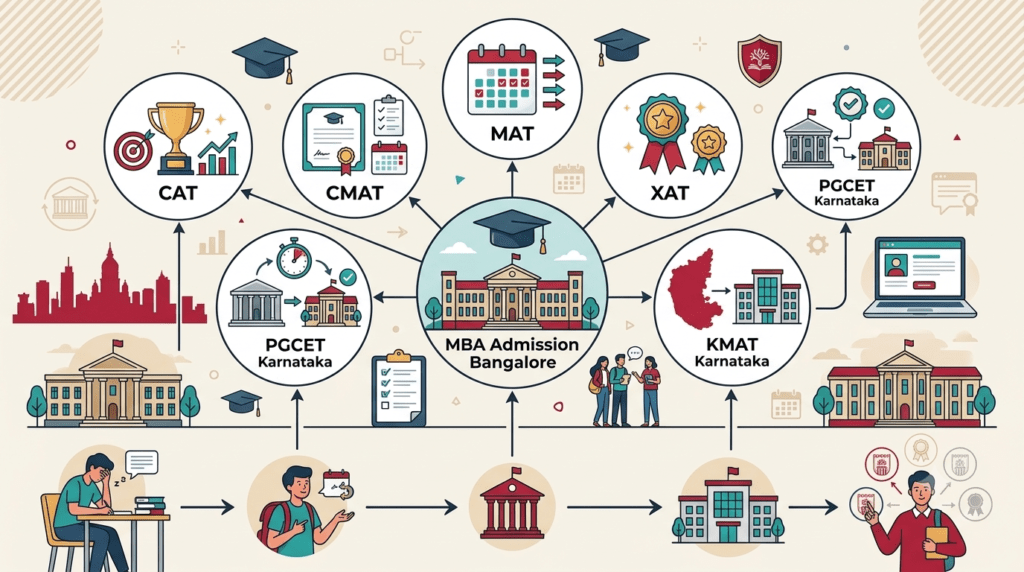
| Entrance Exam | Conducted By | Frequency | RCMB Accepts It? |
| CAT (Common Admission Test) | IIMs (rotating) | Once a year (November) | Yes |
| CMAT (Common Management Admission Test) | NTA (National Testing Agency) | Once a year (January-February) | Yes |
| MAT (Management Aptitude Test) | AIMA | 4 times a year (Feb, May, Sep, Dec) | Yes |
| XAT (Xavier Aptitude Test) | XLRI Jamshedpur | Once a year (January) | Yes |
| KMAT Karnataka | Karnataka Private PG Colleges Association | Twice a year | Yes |
| ATMA | AIMS (Association of Indian Management Schools) | Multiple windows | Yes |
| PGCET Karnataka | Karnataka Examinations Authority (KEA) | Once a year | Yes, for MBA only (not PGDM) |
Note that the Karnataka PGCET test( which is conducted by KEA) is only for regular MBA seats at university-affiliated colleges/institutions.
Which Management Exam Should You Take
At RCMB, there is no single mandatory exam. A valid scorecard from any of the accepted exams is sufficient to apply. The final admission decision is based on the total selection process, which includes the GD and personal interview rounds.
Most students research the entrance exam phase well, then get caught off guard by what comes after it. The GD and personal interview rounds matter as much as your entrance score, and understanding them upfront gives you time to prepare properly.
Entrance Exam and Initial Shortlisting: After you appear for an entrance exam, you submit applications to colleges with your scorecard. Colleges shortlist candidates based on exam score, academic percentage, and in some cases work experience.
Group Discussion: Most Bangalore MBA colleges run a Group Discussion (GD) as the second stage. Typically 10 to 12 candidates are given a business, social, or current affairs topic. You are evaluated on:
Tip– Do not treat GD like a debate, rather consider it like a team discussion/interactive round.
Panel Interview Round: After students clear GD round (general case), they have to face a 15 to 25-minute face-to-face interview. In this round, interviewers( or professors) evaluate academic history, targeted stream, professional vision, experience, skills/trainings/projects, etc.
Note: If you have any existing backlog before taking MBA admission or have any sort of gap in your career timeline, be honest about it. Hiring managers prefer candidates who take responsibility and learn from their past rather than making up excuses
Securing Your Seat: Next, you will get a merit letter if interviewers are impressed by your academic performance and you make the cut in the past rounds. Admissions at run on a continuous rolling schedule. This means you have to claim your seat by submitting admission fees. If you do not submit your fees on time, it will automatically go to the next candidate.
To start the MBA application process, Contact the RCMB admissions team to understand the current admission timeline.
Getting a good placement is important but quality of your faculty department and course curriculum matters more for an MBA program. Good teachers and a practical course can really help you build skills that you will need for your career.
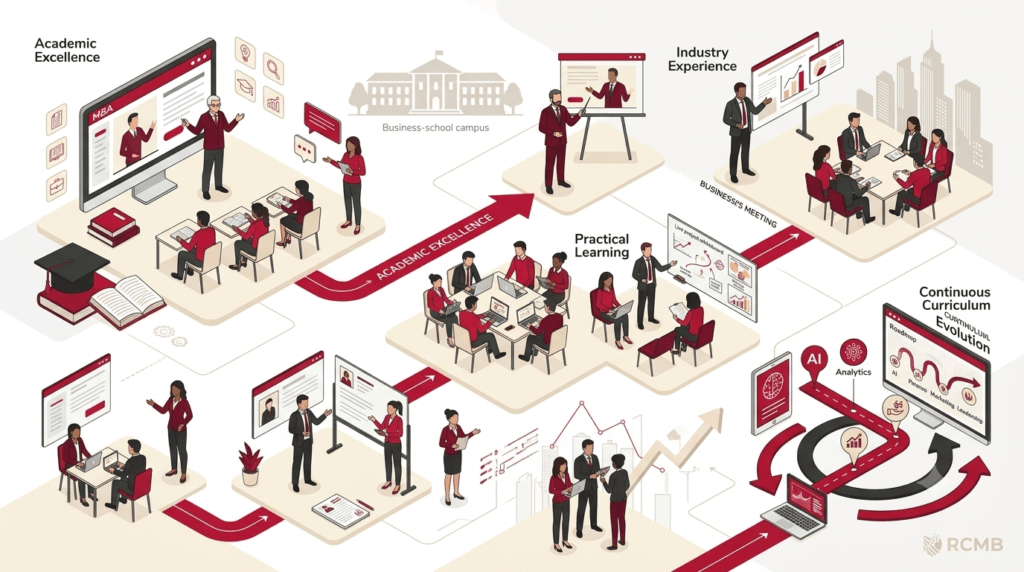
At RCMB, the faculty department has both PhD qualified teachers and industry experts. Here, students learn by working on actual projects. Also, the college runs regular industry programmes including guest lectures and site visits.
For curriculum details at RCMB, visit the RCMB programmes page for MBA admission. For an understanding of what each specialization prepares you for professionally, the guide on top MBA specializations in demand in 2026 covers industry demand, salary outcomes, and career paths for each.
Yes, a good alumni network is the most underrated thing, which students often ignore during admission. If your college has a solid alumni network, it can help you in building your career, and growing your professional network much easier.
| What You Get | Why It Matters |
| Job referrals | Alumni can recommend you for jobs in their companies. |
| Mentoring | Seniors can guide you on careers, salaries, and industry expectations. |
| Professional contacts | Alumni can help with business partnerships, clients, or investments. |
Ways to Evaluate Alumni Network
You can evaluate an MBA college’s alumni network before you join are-
RCMB has a growing alumni network with graduates working in sectors like IT, BFSI, e-commerce, and healthcare at companies including Accenture, HDFC Bank, Amazon, and PhonePe. You can also explore RCMB alumni profiles on LinkedIn to see the recent placement distribution over the last few years.
Before you start applying to MBA colleges, you must spend a few minutes checking these details yourself.
ROI is the most important factor in choosing an MBA college and the most ignored one. Most students compare fees. They rarely calculate payback. Here is a framework that tells you what you actually need to know.
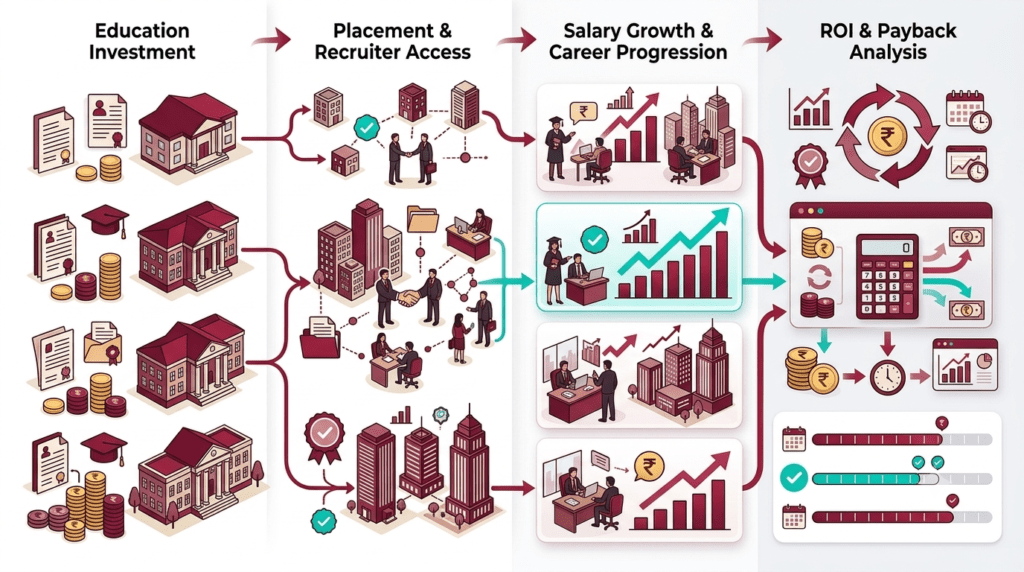
The formula: total MBA cost divided by your expected annual take-home salary gives you the payback period in years. The shorter the payback, the better the ROI.
| College Type | Total Programme Cost | Avg Fresher CTC | Annual Take-Home (Est.) | Payback Period |
| Budget MBA (unaccredited) | Rs. 3-5 Lakhs | Rs. 4-6 LPA | Rs. 3-4.5 Lakhs | Fair payback on paper, but limited recruiter access reduces career ceiling quickly |
| Mid-tier NAAC accredited (RCMB) | Rs. 8.8 Lakhs | Rs. 8.25 LPA | Rs. 5.5-6.5 Lakhs | 13-19 months, strong recruiter network, NAAC A-grade, verified placement data |
| Premium MBA (TAPMI, JAGSoM tier) | Rs. 12-18 Lakhs | Rs. 10-14 LPA | Rs. 7-10 Lakhs | 18-26 months, stronger brand, higher entry cost |
| Tier 1 MBA (IIM-B, SIBM level) | Rs. 23-30 Lakhs | Rs. 20-35 LPA | Rs. 15-25 Lakhs | 14-24 months, highest cost and highest placement ceiling |
The counterintuitive insight: a budget college can actually produce worse ROI than a mid-tier college, because the placement outcomes and recruiter access are proportionally weaker. The payback period calculation forces you to look at both sides at the same time.
At RCMB, the math: Rs. 8.8 Lakhs investment divided by an approximate annual take-home of Rs. 6.2 to Rs. 6.5 Lakhs at the average CTC of Rs. 8.25 LPA gives a payback period of roughly 13 to 14 months. That’s one of the stronger ROI figures among NAAC-accredited mid-tier Bangalore colleges.
For sector-wise salary trajectories at the 2-year and 5-year marks, the MBA salary guide breaks down Bangalore package data by specialization and experience level.
If you want to compare ROI of MBA vs PGDM, read this blog and decide which is better.
Do not depend only on the college website or their brochure. Ask these questions before applying for an MBA-
Before taking admission, avoid these common mistakes.
If you are thinking about MBA hostel facilities in Bangalore, go through this blog. It covers RCMB’s accommodation, free bus service from hostel to campus, and what to check at any college before committing.
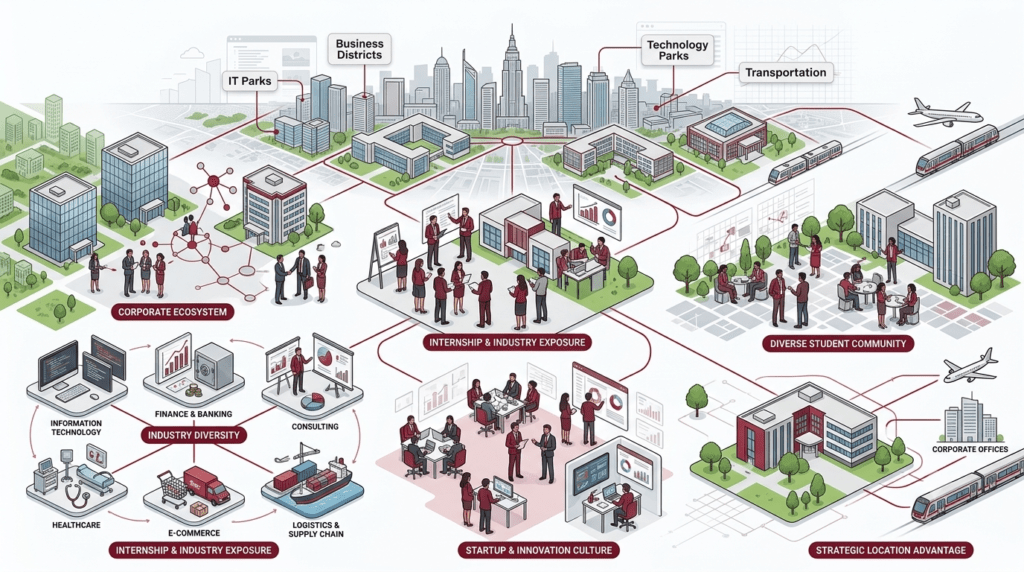
If you want to understand why city Bangalore is a good option for pursuing MBA. Basically, the city has an interconnected corporate ecosystem that simply doesn’t exist anywhere else in the country.
Housing more than 2,000 tech companies, Bangalore generates over 35% of India’s IT exports. Its massive finance, startup, and healthcare sectors offer MBA students unmatched real-world experience.
The Practical Advantages for Students:
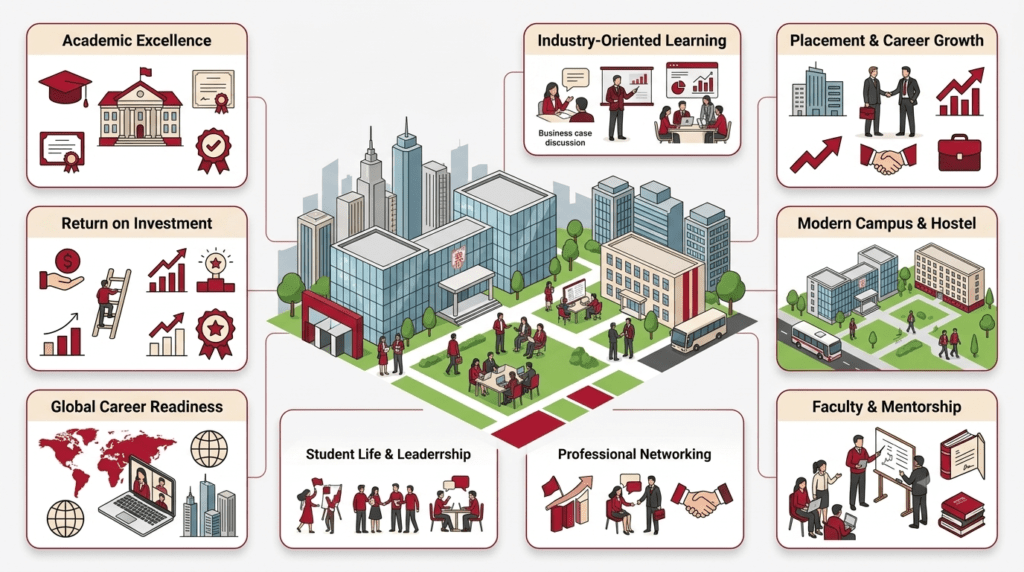
RCMB is worth considering for MBA admission due to the following factors-
Recognition
Who can apply?
Entrance exams accepted
Admission steps
Placement record
Fees
Campus facilities
Learning
Programmes
Don’t rush while choosing an MBA college in Bangalore. Students who spend time researching usually make better decisions than those who rely on rankings or marketing brochures.
A simple process works best. Check eligibility first, then entrance exams, compare MBA and PGDM, verify approvals, review placement records, calculate ROI, and then choose a location that supports your career plans.
Everything shared about RCMB can be verified through public sources. Compare us with other colleges on the same factors and pick the one that gives you the best value for your future.
Start your RCMB research at this About page. Then apply or speak to the admissions team.
Is NAAC A grade enough to judge an MBA college?
A NAAC A grade is generally considered a good sign for many colleges. But candidates must not judge any college based on this ranking only as this accreditation indicates the overall quality of a college. Students must check placement data, alumni network, course quality, faculty, and your ROI for the specific program.
What is a good average package for an MBA in Bangalore?
A good average MBA package depends on the tier of the business school. An IIM Bangalore management graduate can easily get a package of ₹33 to ₹35 LPA or more. However, if you have completed your MBA degree from tier 2 colleges, you can expect a decent package of ₹12 to ₹15 LPA.
Does location of an MBA college in Bangalore matter for placements?
Yes, location of your management college can impact which companies visit it, as recruiters prefer visiting nearby campuses. North colleges in Bangalore draw IT and logistics firms, while Whitefield draws large tech companies and Koramangala attracts startups. So, it is recommended to pick a college near your dream industry to boost your chances of getting hired.
What is the selection process at RCMB for MBA admission?
RCMB admission includes four simple steps which are application, Group Discussion, Personal Interview, and the final merit list. First, you need a good entrance test score. After that, you must pass a group discussion, a personal interview, and have your academic history reviewed.
Is RCMB a good MBA college in Bangalore?
RCMB is a top ranked, NAAC A-grade business school based in Devanahalli, North Bangalore. It provides great job security with a 98.6% placement rate and a Rs. 8.25 LPA average salary at leading companies such as TCS and Amazon. Investing Rs. 8.8 Lakhs in this program is a smart move, as your average salary will pay back the fees in only 13 to 14 months.