
MBA Without CAT in Bangalore 2026: Exams, Colleges and Admission Guide

 By Jai
The most in demand MBA specializations in India in 2026 are Business Analytics, Finance, Marketing, Supply Chain Management, Information Technology Management, Human Resource Management, and Healthcare Management. Business Analytics and Finance are consistently the highest paying MBA specializations in India, with average fresher packages between Rs. 8 and Rs. 15 LPA at NAAC-accredited management colleges. Beyond these core six, specializations in International Business, Operations Management, and Entrepreneurship are seeing growing demand from employers across sectors. The right specialization depends on your target industry, academic background, and career goal.
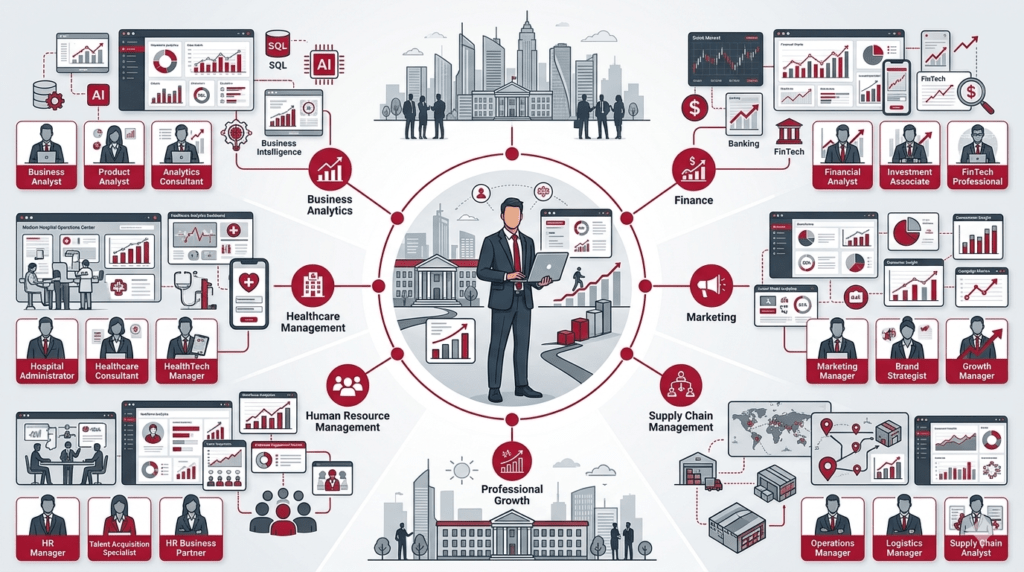
MBA specialization is a focused area of study within the broader MBA programme that allows students to develop deep expertise in a specific business function. Instead of covering all business subjects at an equal surface level, a specialization takes you deeper into the domain that aligns with your career direction.
In India, MBA specialization courses are typically studied in the second year, after a common first-year curriculum covering foundational subjects like management principles, economics, accounting, and organisational behaviour. The specialization you choose in year two determines which companies shortlist you, which roles you qualify for, and which professional network you build.
Here is what the complete MBA specialization courses list looks like across all major domains available in India, along with the core subjects covered in each:
| MBA Specialization | Core MBA Specialization Subjects | Primary Hiring Sector |
| Business Analytics | Data Analysis, Statistical Modelling, BI Tools, SQL, Predictive Analytics | IT, Consulting, E-commerce |
| Finance | Financial Modelling, Corporate Finance, Investment Analysis, Risk Management | BFSI, FinTech, NBFCs |
| Marketing | Digital Marketing, Consumer Behaviour, Brand Management, Market Research | FMCG, E-commerce, Startups |
| Supply Chain Management | Demand Planning, Logistics, Procurement, ERP Systems (SAP, Oracle) | E-commerce, Manufacturing, 3PL |
| Human Resource Management | HR Analytics, Talent Acquisition, Organisational Behaviour, Compensation | IT Services, MNCs, Consulting |
| Healthcare Management | Hospital Administration, Health Policy, HealthTech, Healthcare Finance | Hospital chains, Pharma, HealthTech |
| Information Technology Management | IT Strategy, Digital Transformation, Cybersecurity, AI Systems Management | IT firms, MNCs, Tech startups |
| International Business | Global Trade, Cross-border Strategy, Export-Import, Foreign Exchange | MNCs, Export firms, Trading companies |
| Operations Management | Production Planning, Quality Control, Process Optimisation, Six Sigma | Manufacturing, Retail, FMCG |
| Entrepreneurship | Startup Fundamentals, Venture Financing, Business Planning, Innovation Mgmt | Startups, VCs, Corporate Innovation |
MBA specialization subjects in your chosen domain are studied alongside electives that give you exposure to adjacent functional areas. This structure ensures you develop both depth in your specialization and reasonable breadth across other business functions.
The MBA landscape in India has shifted decisively toward specialization. Companies no longer hire general management graduates the way they did a decade ago. A Mumbai-based FinTech startup wants an MBA Finance graduate who understands derivatives and digital payments. A logistics firm wants an MBA Supply Chain professional who can manage last-mile fulfilment and ERP systems. In MBA, which specialization is best depends entirely on your target sector.
| Best MBA Specialization Courses | India Demand Level | Avg Fresher CTC (India) | Top Growth Sector |
| Business Analytics | Very High | Rs. 8-18 LPA | IT, Consulting, E-commerce |
| Finance | Very High | Rs. 7-15 LPA | BFSI, FinTech, NBFCs |
| Information Technology Management | High | Rs. 8-15 LPA | IT firms, Tech startups, Digital transformation |
| Marketing | High | Rs. 6-10 LPA | E-commerce, FMCG, D2C Brands |
| Supply Chain Management | High | Rs. 7-12 LPA | E-commerce, Logistics, Manufacturing |
| Human Resource Management | Moderate-High | Rs. 6-9 LPA | IT Services, MNCs, Consulting |
| International Business | Growing | Rs. 6-12 LPA | MNCs, Export firms, Global trading |
| Healthcare Management | Growing Fast | Rs. 6-10 LPA | Hospital chains, HealthTech, Pharma |
| Operations Management | Moderate | Rs. 6-10 LPA | Manufacturing, Retail, FMCG |
| Entrepreneurship | Niche but Growing | Startup-linked | Startups, VC ecosystem, Incubators |
RCMB offers Business Analytics, Finance, Marketing, HRM, Supply Chain Management, and Healthcare Management under both MBA and PGDM programmes.
Business Analytics is the MBA specialization in highest demand in 2026, followed closely by Finance. Companies across IT, consulting, BFSI, and e-commerce are building data-driven teams, which has pushed Analytics ahead of traditional choices like Marketing and HR Management. Finance holds its position because of the continued growth of FinTech and digital banking across India’s major financial hubs.
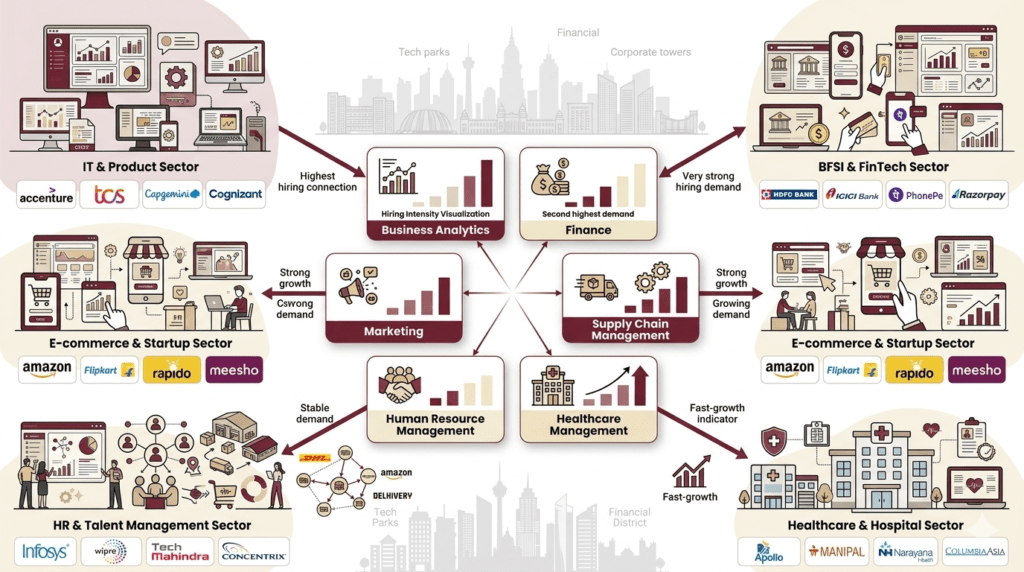
If you look at the actual hiring patterns across India’s major industry sectors, the demand picture looks like this:
| Industry Sector (Major Hubs) | Primary MBA Specialization Hired | Top Companies Recruiting | Why This Specialization |
| IT and Product | Business Analytics | Accenture, TCS, Infosys, Capgemini, Cognizant | Data-driven decisions, BI and analytics roles |
| BFSI and FinTech | Finance | HDFC Bank, ICICI, Axis Bank, PhonePe, Razorpay | Risk management, FinTech product and banking roles |
| E-commerce and Startups | Marketing | Amazon, Flipkart, Meesho, Nykaa, D2C brands | Brand, performance marketing, growth and category roles |
| Manufacturing and Supply Chain | Supply Chain Management | Bosch, Mahindra, Tata, DHL, Blue Dart | Demand planning, procurement, vendor management |
| MNC HR and IT Services | Human Resource Management | Infosys, Wipro, Concentrix, Tech Mahindra | HR analytics, talent acquisition, HRBP roles |
| Healthcare and Pharma | Healthcare Management | Apollo, Manipal, Narayana, Sun Pharma, Cipla | Hospital operations, pharma marketing, HealthTech |
| International Trade and Global MNCs | International Business | Export firms, Trading companies, MNC branches | Cross-border strategy, global trade, FX management |
| Digital Transformation and Tech Strategy | IT Management | Wipro Digital, Capgemini Invent, Deloitte Digital | IT project management, digital transformation leadership |
According to NASSCOM’s annual technology sector report, India needs more than 1.5 million analytics professionals by 2027, making Business Analytics the MBA specialization with the most consistent hiring volume across Indian cities in 2026.
For a detailed breakdown of what these specialization choices mean for your earning potential by sector and experience level, read our comprehensive MBA salary guide.
Five years ago, Finance and Marketing were the safe choices and Analytics was the emerging option nobody quite understood. By 2026, that ranking has shifted completely. Business Analytics has moved from experimental to mainstream. Healthcare Management has gone from a niche area to one of the fastest-growing categories in management education across India.
The All India Council for Technical Education (AICTE) has approved more emerging specializations since 2022 than in the previous decade, including programmes in AI Management, HealthTech, and Supply Chain Analytics, reflecting how quickly India’s employer demand has shifted.
Choosing the best MBA specialization course for 2026 is one thing. Choosing the one with the most scope over the next decade is a more important and more difficult question. Here is how the major specializations compare on long-term career relevance in India:
| MBA Specialization | 5-Year Scope (India) | 10-Year Scope (India) | Key Growth Driver |
| Business Analytics | Excellent | Excellent | AI augments the role; more data means more need for human interpretation |
| Finance (FinTech focus) | Excellent | Very Good | India’s fintech market projected to reach $1T AUM by 2030 |
| IT Management | Excellent | Excellent | Digital transformation across every Indian industry sector |
| Healthcare Management | Very Good | Excellent | India’s healthcare sector growing toward Rs. 53 lakh crore by 2030 |
| Supply Chain Management | Very Good | Very Good | E-commerce and manufacturing expansion; logistics professionalisation |
| International Business | Good | Very Good | India’s growing role in global trade and rising MNC investment |
| Marketing (Digital focus) | Good | Good | Digital ad spend growing but AI is automating execution; strategy stays protected |
| Human Resource Management | Good | Good | HR Analytics roles growing; administrative HR shrinking |
| Entrepreneurship | Growing | Strong | India is the world’s third-largest startup ecosystem with 100+ unicorns |
For students asking which MBA specialization is best for high salary over a 10-year horizon, Business Analytics and Finance in FinTech contexts rank highest. But future scope and highest salary are not always the same answer. Healthcare Management has exceptional long-term scope with more moderate early salaries. IT Management has both strong early salary and strong future relevance. Business Analytics currently sits at the top of both charts.
The highest paying MBA specialization question is the one most students ask first and the one most articles answer with ranges so broad they are useless. Here is a more honest picture based on NIRF placement data and verified industry reports across India’s top management colleges.
Based on NIRF Management Rankings 2024 placement data, average placement packages at mid-tier management colleges in India range from Rs. 6 to Rs. 12 LPA. At Tier 1 institutions, packages range from Rs. 15 to Rs. 35 LPA depending on specialization. Specialised PGDM programmes in Business Analytics are seeing 20 to 25% faster salary growth in the first three years compared to general management graduates.
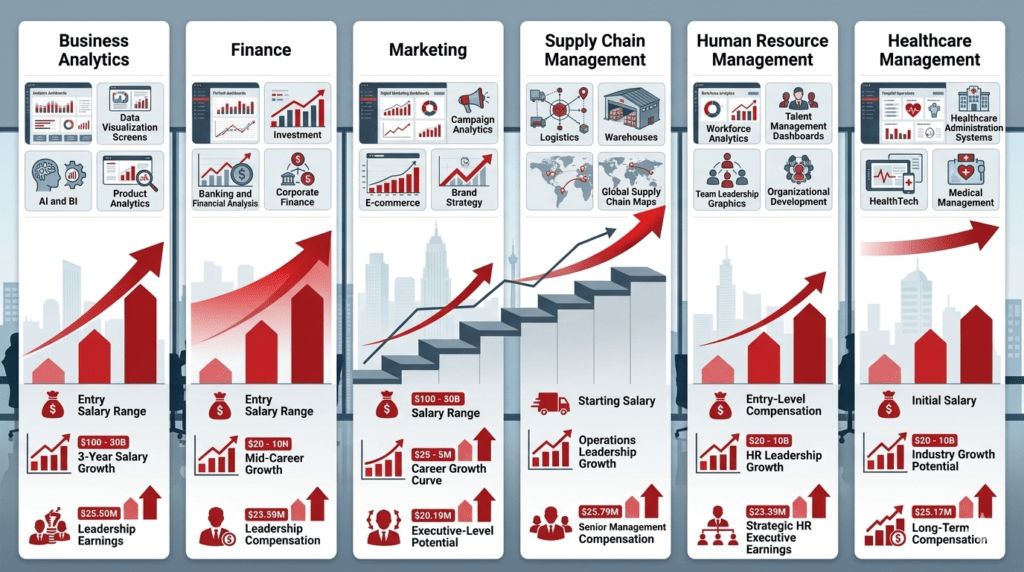
| Specialization | Avg Fresher CTC in India | 3-Year Salary Range | Highest Paying Role at 5+ Years |
| Business Analytics | Rs. 8-18 LPA | Rs. 14-25 LPA | Analytics Manager, Product Manager: Rs. 22-40 LPA |
| Finance | Rs. 7-15 LPA | Rs. 12-22 LPA | Finance Manager, FinTech Lead: Rs. 18-35 LPA |
| IT Management | Rs. 8-15 LPA | Rs. 14-22 LPA | IT Director, Digital Transformation Head: Rs. 20-35 LPA |
| International Business | Rs. 6-12 LPA | Rs. 12-20 LPA | International Business Manager, Trade Head: Rs. 18-28 LPA |
| Marketing | Rs. 6-10 LPA | Rs. 10-16 LPA | Marketing Manager, Growth Head: Rs. 16-26 LPA |
| Supply Chain Management | Rs. 7-12 LPA | Rs. 12-18 LPA | SCM Head, Operations Head: Rs. 15-25 LPA |
| Human Resource Management | Rs. 6-9 LPA | Rs. 9-14 LPA | HR Business Partner, CHRO Track: Rs. 14-22 LPA |
| Healthcare Management | Rs. 6-10 LPA | Rs. 10-16 LPA | Hospital Director, HealthTech Lead: Rs. 15-25 LPA |
| Operations Management | Rs. 6-10 LPA | Rs. 10-16 LPA | Operations Head, COO Track: Rs. 15-22 LPA |
For students considering careers outside India, the salary picture changes significantly. Finance (Investment Banking and Private Equity) reaches Rs. 1 crore plus at senior levels in global markets. Consulting roles at McKinsey, BCG, and Bain start at Rs. 75 lakh to Rs. 1 crore for top-tier MBA graduates internationally. Business Analytics and IT Management are the most internationally transferable specializations, with Indian MBA graduates finding roles in Singapore, UAE, the UK, and the US at starting packages significantly above the Indian equivalents.
Business Analytics is the top-ranked MBA specialization for India’s job market in 2026. Every major employer across IT, BFSI, e-commerce, and consulting is building data teams that need managers who understand both the business context and the analytical toolkit. For students targeting Product Manager roles at tech companies, Analytics is also the strongest foundation because PMs need to interpret data, run A/B tests, and build business cases from usage metrics.
Finance is the most consistently hireable MBA specialization in India. It is the direct answer for students asking which specialization is best in MBA for banking. It is also a strong choice for students interested in business ownership and entrepreneurship because understanding cash flow, valuations, and funding structures is the practical foundation of running any company.
Finance plus Analytics as a dual specialization creates a FinTech profile that is among the most sought-after across India’s BFSI sector, with salary premiums of 15 to 20% over standalone Finance graduates.
Marketing MBA in 2026 is not what it was in 2016. If your Marketing programme does not cover digital marketing, performance analytics, and consumer data strategies, you are learning a version of the subject that most Indian employers are moving away from. The strongest Marketing MBAs today are built around digital-first thinking.
Marketing graduates with a strong internship portfolio in digital campaigns consistently outperform those without practical experience at the placement stage. The MBA degree gets you the interview. The internship track record gets you the offer.
HRM has quietly become a data-intensive specialization across India’s major employers. HR Analytics, people operations, and workforce planning using HRMS platforms are now standard expectations at large IT companies, MNCs, and consulting firms. The job title might say HR but the work involves a significant amount of data interpretation.
HRM offers a clear career progression path: HR Executive to HRBP to HR Manager typically happens within 4 to 5 years at major Indian employers. HRM graduates who add analytics skills through electives or dual specialization see faster movement to senior roles.
Supply Chain is having its moment in India. The post-2020 supply chain disruptions globally accelerated demand for professionally trained operations managers, and the e-commerce boom in India has kept that demand elevated. Supply Chain is now one of the most in-demand MBA specializations across India’s manufacturing belts, logistics hubs, and e-commerce fulfilment networks.
Supply Chain is one of the specializations least likely to be replaced by AI in the near term because it involves real-world coordination, vendor relationships, and on-the-ground problem-solving that automation handles poorly. It is a stable, growing choice for students who prefer operations over office analytics roles.
Healthcare Management is the most underrated MBA specialization in India right now. The country has one of the fastest-growing hospital chains, HealthTech startup ecosystems, and pharmaceutical sectors in Asia. And all of them need MBA graduates who understand both operations management and healthcare delivery.
India’s healthcare sector is projected to reach a market size of Rs. 53 lakh crore by 2030, according to IBEF Healthcare India sector reports. Hospital chains like Apollo, Manipal, Narayana, and Fortis are expanding rapidly. HealthTech companies like Practo, 1mg, and PharmEasy are scaling across Tier 1 and Tier 2 cities.
Healthcare Management graduates face less placement competition than Finance or Analytics graduates because far fewer students choose this specialization. That lower competition relative to a smaller pool of specialist roles creates a real placement advantage for students who pick it with conviction.
MBA in IT Management is one of the fastest-growing specializations in India in 2026. As every major industry undergoes digital transformation, companies need managers who understand both business strategy and technology systems. This specialization bridges that gap.
IT Management is particularly strong for engineering graduates making the switch to management. The technical foundation from an engineering degree combined with MBA-level business and strategy skills creates a profile that employers across tech services, consulting, and financial services actively seek.
MBA in International Business is gaining traction as India’s role in global trade expands. With India’s merchandise exports crossing $450 billion annually and more global MNCs expanding India operations, graduates who understand cross-border commerce, international regulations, and multi-currency financial management are increasingly valuable.
International Business is the strongest specialization for students who want to work for global corporations, embassy-linked trade organisations, or firms that operate across multiple countries. It also pairs well with Finance for students targeting international banking and trade finance roles.
Most MBA guides tell you to choose a specialization based on your interests. That is not wrong but it is not useful either. Here is a more practical mapping based on academic background and career experience:
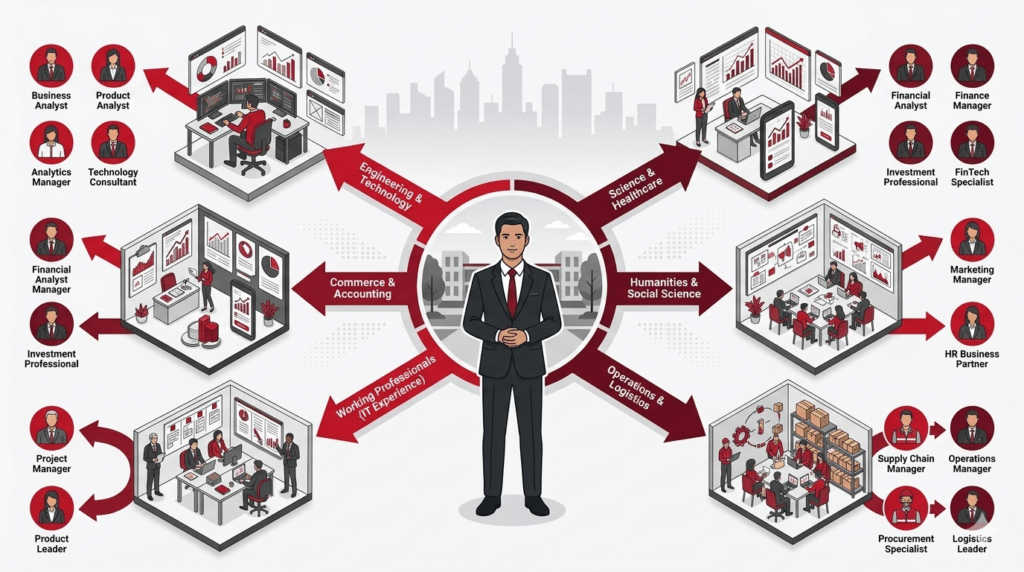
| Your Background | Recommended Specialization | Why This Works | Typical Entry Role in India |
| Engineering or Computer Science | Business Analytics or IT Management | Tech background plus business skills = highest premium at IT, product companies | Business Analyst, Data Analyst, Product Analyst |
| Commerce or Accounting | Finance | Existing foundation, fastest route to BFSI and FinTech roles | Financial Analyst, Credit Analyst, Investment Banking |
| Science or Pharma | Healthcare Management | Domain knowledge gives instant credibility at hospital chains and pharma firms | Healthcare Operations, Medical Marketing, Clinical Admin |
| Humanities or Social Sciences | Marketing or HRM | People skills plus brand thinking fit digital marketing and HR Business Partner roles | Brand Executive, Talent Acquisition, Growth Analyst |
| 3+ years IT experience | Analytics or IT Management | Leverage domain expertise, move into management with a tech advantage | Analytics Manager, IT Project Manager, Product Manager |
| Operations or logistics background | Supply Chain Management | Industry context plus MBA = direct path to senior ops roles | SCM Lead, Operations Manager, Procurement Head |
| International work or study experience | International Business | Cross-cultural exposure plus management skills opens global trade and MNC roles | International Business Manager, Trade Finance Analyst |
If you are specifically weighing the programme type alongside the specialization choice, our PGDM vs MBA comparison guide covers the programme structure difference separately, which often confuses students who are researching both simultaneously.
The most useful version of the specialization question is not which is best overall but which is best for what you specifically want to do. Here is a goal-to-specialization map based on India’s actual hiring patterns in 2026:
| Career Goal | Best MBA Specialization | Why | Typical Entry Role |
| Management Consulting (McKinsey, Deloitte, BCG) | Business Analytics | Case-based thinking and quantitative analysis skills are core consulting requirements | Business Analyst, Consultant Trainee |
| CEO or Business Head track | Finance or General Management | CEOs most commonly rise from Finance and Strategy backgrounds at Indian companies | Management Trainee at FMCG or Consulting |
| Product Manager at a tech company | Business Analytics | Data literacy plus business thinking is the core PM profile across Indian tech firms | Product Analyst, Associate Product Manager |
| Banking career in India | Finance | Direct domain knowledge, fastest route to roles at major banks and NBFCs | Financial Analyst, RM, Credit Analyst |
| Building or running a business | Finance or Entrepreneurship | Understanding cash flow, funding, and market strategy is the practical business owner toolkit | Business Development, Founder track, Growth |
| Digital marketing or e-commerce | Marketing plus Analytics (dual) | Dual-skill set matches what major Indian e-commerce and startup employers want | Growth Manager, Marketing Manager, Category Manager |
| Hospital or healthcare career | Healthcare Management | Domain-specific, fastest track to senior hospital and HealthTech roles | Operations Executive, Medical Marketing Manager |
| Global or MNC career | International Business or Finance | Cross-border expertise plus management skills opens doors at global corporations | International Business Manager, Trade Finance |
This is the question most MBA guides avoid because it is uncomfortable. But students asking it deserve a direct answer.
The World Economic Forum Future of Jobs Report 2025 projects that while millions of jobs will be displaced by automation by 2027, a larger number of new roles will emerge. The pattern is clear: routine, rules-based tasks are automated; roles requiring judgment, creativity, and cross-functional coordination are growing.
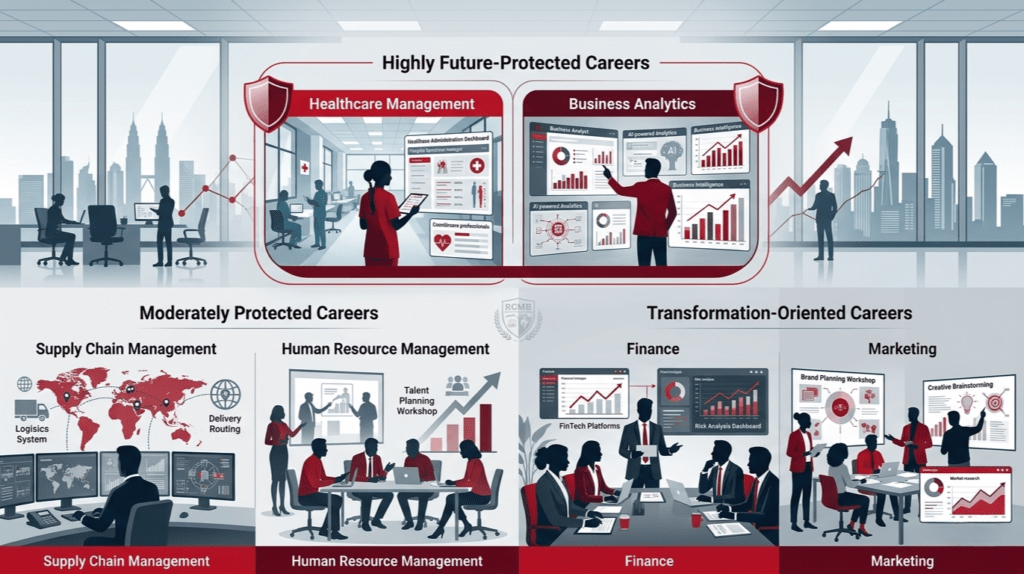
| Specialization | Automation Risk Level | What Is at Risk | What Stays Protected |
| Business Analytics | Low (growing with AI) | Basic data entry and standard reporting | Strategy consulting, BI interpretation, human-AI decision-making |
| Finance | Medium (mixed) | Routine bookkeeping and basic compliance reporting | Corporate strategy, M&A advisory, FinTech product management |
| Marketing | Medium (mixed) | Mass content creation and templated ad campaigns | Brand strategy, customer insight, creative leadership |
| IT Management | Low (growing with AI) | Basic IT support and standard admin tasks | AI governance, digital transformation leadership, cybersecurity strategy |
| Supply Chain Management | Medium-Low | Routine inventory tracking and purchase orders | Complex vendor negotiations, crisis logistics, multi-country coordination |
| Human Resource Management | Low to Medium | CV screening, payroll processing, compliance documentation | HRBP roles, organisational design, talent strategy, conflict resolution |
| Healthcare Management | Low (most protected) | Administrative scheduling and billing documentation | Clinical operations, hospital strategy, HealthTech advisory |
| International Business | Low | Standard documentation and compliance reporting | Cross-cultural negotiation, market entry strategy, global relationship management |
A note on difficulty: which MBA specialization is easy to study is a separate question from which is most future-proof. Healthcare Management and HRM are often considered more accessible academically. Business Analytics and IT Management are the most technically demanding. Choose based on career goal and risk tolerance, not difficulty level.
MBA dual specialization means completing the coursework for two specialization areas within your MBA or PGDM programme instead of one. In most Indian programmes, this is achievable within the standard two-year duration because electives from the second specialization replace free electives in the normal curriculum.
| Factor | Single Specialization | MBA Dual Specialization |
| Depth of knowledge | Very deep in one domain | Deep in primary, working proficiency in secondary |
| Career flexibility | Strong in one sector | Stronger across two sectors simultaneously |
| Salary premium in India | Standard for specialization | 15 to 20% premium for right combinations |
| Course load | Standard | Slightly heavier per semester |
| Best for | Very clear, specific career target | Target sectors that value cross-functional expertise |
The dual specialization combinations that create the strongest salary premiums in India’s job market:
Single specialization is better when you have a very clear, specific career target. Finance for investment banking. Healthcare for hospital management. International Business for global trade roles. Dual specialization is better when your target sector values cross-functional expertise, which is increasingly the case in FinTech, e-commerce, and consulting across India.
RCMB’s PGDM programme supports dual specialization. For programme structure details, visit the RCMB PGDM programme page.
Choosing the right MBA specialization is a career decision, not just a course selection. Here is a practical six-step framework:
If you are genuinely undecided, Business Analytics is the safest default choice for India’s job market in 2026. It is the most versatile, the most in-demand, and the specialization with the lowest risk of becoming obsolete. It is not the right answer for everyone, but it is the strongest general-purpose MBA specialization available right now.
If you have shortlisted RCMB and need to pick a specialization, here is the breakdown. The campus, faculty, placement team, and recruiter network are identical for all six specializations at RCMB. The decision comes down entirely to your career direction.
Explore the full placement outcomes and recruiter details at the RCMB. For entry requirements, the MBA eligibility requirements guide and the PGDM eligibility requirements guide cover both entry routes in complete detail.
Most students spend more time choosing a laptop than choosing their MBA specialization. That is the wrong priority. Your specialization shapes the companies that shortlist you, the roles you qualify for, the salary range you start in, and the professional network you build over the next decade in India’s job market. Choosing the right specialization starts with choosing the best MBA college, where industry exposure, career guidance, and placement preparation are built into the learning experience.
The top MBA specializations in demand in India in 2026 are clearly defined. Business Analytics and Finance lead on salary and hiring volume. IT Management and Healthcare Management lead on growth trajectory. Marketing, HRM, Supply Chain, International Business, and Operations Management each serve a specific sector well. The best MBA specialization is the one that fits your background, your career target, and your long-term risk tolerance.
Ready to apply? If you want to talk through which specialization fits your profile before deciding, the RCMB admissions team can help you work through it before you commit.
Business Analytics and Finance consistently rank as the highest paying MBA specializations in India in 2026. Business Analytics fresher roles range from Rs. 8 to Rs. 18 LPA at well-placed colleges, with mid-career roles reaching Rs. 22 to Rs. 40 LPA. Finance follows closely, particularly for FinTech and investment banking roles at major Indian financial institutions and global firms.
Business Analytics is the highest-demand MBA specialization in India in 2026, driven by demand from IT companies, consulting firms, and e-commerce players across all major cities. Finance follows due to the growth of India’s FinTech sector. Healthcare Management is the fastest-growing emerging specialization with demand rising faster than the supply of trained graduates.
The major MBA specializations available in India include Business Analytics, Finance, Marketing, Human Resource Management, Supply Chain Management, Healthcare Management, Information Technology Management, International Business, Operations Management, and Entrepreneurship. Most MBA and PGDM programmes offer a common first year followed by specialization choices in the second year. Some institutions also offer emerging specializations in AI Management, FinTech, and Sustainability.
Business Analytics is the most natural switch for IT professionals because it builds on technical reasoning while adding business strategy and management skills. IT Management is a strong alternative for those who want to stay close to project delivery and technology governance. Both specializations see strong hiring from tech firms, consulting companies, and digital transformation practices across India.
Yes, dual specialization is available in many MBA and PGDM programmes across India, including RCMB. The combinations that create the strongest salary premiums in India’s job market are Finance plus Analytics for FinTech roles, Marketing plus Analytics for e-commerce, IT Management plus Analytics for technology consulting, and HRM plus Analytics for large IT services companies. Dual specialization graduates typically earn 10 to 20% more than single-specialization peers within three years.
Healthcare Management is the most protected MBA specialization from AI automation because hospital operations and clinical management require physical presence and human judgment. Strategic HR, IT governance, and advisory Finance roles are also strongly protected. The highest automation risk falls on routine reporting, basic data entry, and standard administrative tasks within any specialization.
Start with your target sector and work backwards from the companies you want to interview at. Map your academic background to the specialization that complements your existing strengths. Check actual placement reports from your shortlisted college for recruiter names and packages by specialization. If you are undecided, Business Analytics is the safest default choice for India’s private sector job market in 2026.
Business Analytics is the best MBA specialization for management consulting in India. Firms like Accenture, Deloitte, KPMG, and McKinsey require case-based thinking and strong quantitative analysis skills that Analytics programmes directly develop. Finance is the second-best choice for financial advisory and strategy consulting. Both are available at RCMB under MBA and PGDM programme structures.