
MBA Without CAT in Bangalore 2026: Exams, Colleges and Admission Guide
 By Jai
MBA admissions in Bangalore fall into two paths depending on the college you choose. University colleges require a state exam, counselling and seat allotment by KEA. On the other hand, private management schools accept national scores and conduct their own interviews. These private colleges take entrance exams like CAT, MAT, CMAT, or KMAT, followed by GD and PI rounds.
The total fees of MBA admission span from ₹1 Lakh to ₹25 Lakhs and candidates can easily earn back the cost within 3 to 5 years through higher CTC packages and quicker promotions.
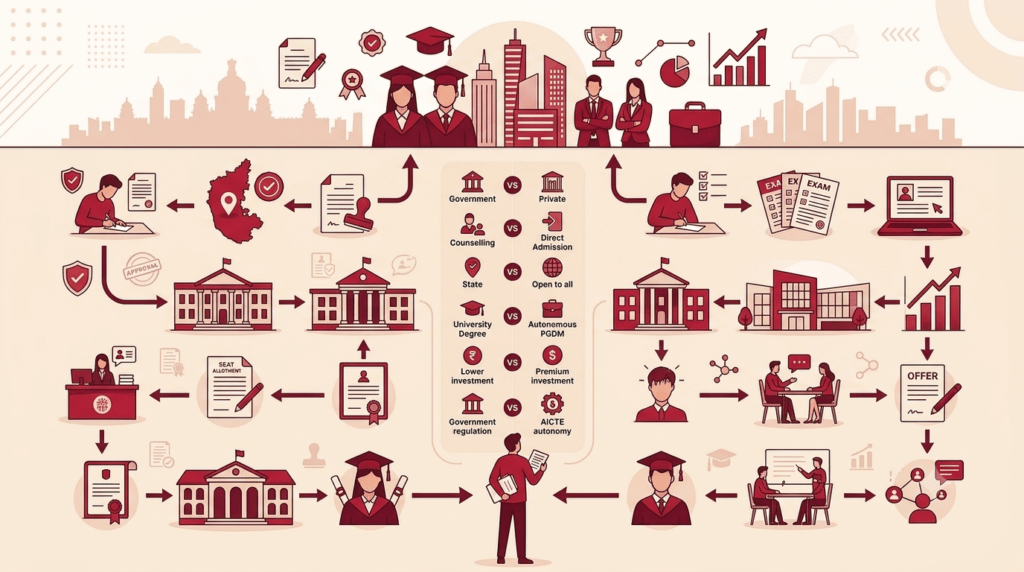
Getting MBA admission in Bangalore in 2026 is not a single pathway. The process you follow depends entirely on which type of programme you’re targeting. Students who treat all MBA admission in Bangalore as one process end up confused about why their PGCET score didn’t work at a PGDM college, or why their CAT score didn’t get them into a government university-affiliated college at the fee range they expected.
The two routes are structurally different:
| Feature | PGCET Route (Govt Quota) | National Exam Route (Private) |
| What it covers | University-affiliated MBA in Karnataka | Private MBA and PGDM colleges across Bangalore |
| Exam required | Karnataka PGCET | CAT, CMAT, MAT, XAT, KMAT, ATMA, or GMAT |
| Seat allotment | Through KEA counselling | Direct application to college |
| Fee range | Rs. 50,000 to Rs. 2 Lakhs (govt quota) | Rs. 6 Lakhs to Rs. 18 Lakhs |
| Domicile requirement | Karnataka domicile for govt quota | None; open to all Indian students |
| Programme output | University degree (UGC-regulated) | Degree (university-affiliated) or Diploma (AICTE-approved PGDM) |
The All India Council for Technical Education (AICTE) governs autonomous PGDM programmes while the University Grants Commission (UGC) governs university-affiliated MBA degrees. These two regulatory frameworks create the two admission routes. Understanding which regulatory framework your target college falls under is the first thing to settle before you start your admission for MBA in Bangalore.
Before going further, confirm you meet the basic marks and exam requirements. The complete MBA eligibility guide for Bangalore covers minimum marks, entrance exam options, Karnataka category rules, and who qualifies for which route.
Also, this PGDM vs MBA comparison blog can guide you to choose the career which is suitable for you. It covers everything related to the curriculum of the management courses, exam criteria, job eligibility, and salary packages.
To get into a MBA program in Bangalore, you need to clear relevant entrance tests, apply and shortlist colleges, pass their selection (GD/PI) rounds and pay initial fees.
Take a look at the steps from exam to offer letter, laid out in the order it actually happens.
MBA admission mainly starts with an entrance exam score. Here, CAT is not the only option to get admission. Most government and private colleges accept a range of national and state exams.
For example, CMAT is conducted by NTA or National Testing Agency and it is accepted at more than 1,000 AICTE-approved colleges including most mid-tier private MBA and PGDM colleges in Bangalore. If you missed CMAT, MAT is the next best option, which you can take four times in a year.
You can start looking for your dream management college before your exam results are out. You can compare colleges based on NAAC grade/accreditation data, placement average and median salary, fee structure and ROI and specializations offered. Also, you must check the location before you choose the right MBA college in Bangalore. It will give you an extra advantage to take part in corporate networking and work in internships, live projects, etc.
Generally, most of the private management colleges in Bangalore run their rolling admissions from November through April. You can apply to 3 to 5 colleges simultaneously instead of waiting for one result. Each application typically requires your entrance exam scorecard, academic marksheets, and ID proof at this stage.
This is the perfect state level exam for Karnataka domicile students applying for govt. quota in university-affiliated MBA colleges. The exam was held on June 14, 2026 and the next PGCET cycle begins in early 2027.
After the MBA application gets shortlisted, candidates are called for GD and PI rounds. At some colleges, Group Discussion and Personal Interview rounds happen online while others hold them on campus.
After the GD/PI, colleges issue offer letters to selected candidates. Pay the initial admission fee within the specified window to confirm the seat. Most Bangalore colleges require initial payment within 7 to 15 days of the offer letter. Seats are not held beyond this window.
Before classes begin, submit all required documents which include
The given timeline can change with the business school and the admission method. Usually, most management colleges start their batches in July or August.
Karnataka PGCET is the state entrance test that opens up the government quota route for MBA college admission in Bangalore. The exam is one part of a multi-step process. What happens after the exam, the counselling process, is less well understood and is where most students lose opportunities.
PGCET is conducted by the Karnataka Examinations Authority (KEA). In 2026, the MBA PGCET exam was held on June 14. The answer key was released June 15. Results and counselling follow in July and August 2026.
Counselling is the process that converts your PGCET rank into an actual seat at a specific MBA college. Here is what happens:

There are different selection rounds you need to clear before taking admission in MBA & PGDM College in Bangalore–
The GD round mainly tests communication/listening skills and how you handle disagreement. Here the evaluator is not looking for who ‘wins.’, rather they want to see you add smart ideas while working well with others.
In most colleges, the PI round runs between 15 and 25 minutes. While the number of interviewers varies from one to three, the questions remain mostly the same-
| PI Question Category | Example Questions | What’s Being Evaluated |
| Why MBA | Why do you want an MBA? Why now? | Career clarity and motivation |
| Why this college | Why did you choose this college and programme? | Research, fit, genuine interest |
| Specialization fit | Why Marketing? What will you do with it after? | Domain awareness, career intent |
| Academic background | You scored 72% in graduation. What happened in third year? | Honest answers, Self-awareness |
| Work experience (if there is any) | Walk me through your last role. Why are you leaving? | Professional growth |
| Current affairs and GK | What is your view on the recent rate decision taken by RBI? | Awareness, analytical thinking |
| Strengths and weaknesses | Share one weakness that really affects your work. | Genuine answers |
During some MBA admissions, you may have to write a 20 to 30-minute opinion essay on a business or news topic. Here the evaluation is done based on your writing skills and analytical thinking.
Not all colleges include this WAT round, so be sure to check the specific process for each college.
How Colleges Weigh Different Components in the Final Selection
| Selection Component | Typical Weightage at Mid-Tier Bangalore Colleges |
| Entrance exam score (CAT/CMAT/MAT etc.) | 30 to 40% |
| GD/PI performance | 35 to 45% |
| Academic record (graduation marks) | 10 to 20% |
| Work experience (if any) | 5 to 10% |
| WAT (where applicable) | 5 to 10% |
A great interview and group discussion can easily save a decent entrance test score. However, a poor interview will ruin a high test score and cost you your dream seat, meaning both stages need your full focus.
Doing an MBA in Bangalore can cost you anything from ₹1 lakh up to over ₹25 lakh for two years. However, premium institutes such as IIM Bangalore or NMIMS take the highest fees, while government universities and average private schools are comparatively more pocket-friendly. However, at most private institutes, the total fee is broken down into installments.
| College Type | Programme Fee (Full 2 Years) | PGCET Govt Quota | What’s Usually Included |
| Government university MBA colleges | Rs. 50,000-1.5 Lakhs | Yes (domicile needed) | Tuition only; hostel, books, exams extra |
| Private NAAC-accredited (mid-tier) | Rs. 6-10 Lakhs | No | Tuition, lab, library, placements; hostel often separate |
| Strong private B-schools (TAPMI, JAGSoM tier) | Rs. 10-16 Lakhs | No | Tuition, activities, placement support; hostel sometimes included |
| Premium MBA (top 20 private like IIM-B exec) | Rs. 20-30 Lakhs | No | Full programme, international exposure, alumni access |
MBA Admission Fees Breakdown: What Students Often Miss
MBA admission depends on your exam performance, profile, and the college’s admission process. Work on the areas you can improve and plan your applications early.
1. Entrance exam score: This is the most important part you can control. A CMAT percentile between 70 and 80 or a MAT score above 600 helps you apply to many good private colleges. A CAT score above 85 percentile improves your chances at leading institutes. Preparing for 3–4 months before MAT is usually more effective than appearing for CAT without enough preparation.
2. GD and PI skills: Join group discussion practice sessions instead of only studying concepts. You can practice some common questions ( related to business news, latest management trends, etc.), record your answers, and improve the parts that sound unclear.
3. Academic performance: Graduation marks are considered during admission. If your score is under 60%, explain the reason confidently. Recent learning, certifications, or work achievements can balance older academic scores.
4. Overall profile: Adding internships, certificates, and leadership or team projects makes your profile stronger. For regular colleges, taking part in business competitions or running events is the best way to shine when grades are tied.
1. College diversity goals: Some colleges balance admissions based on gender, location, and education background. Male engineering graduates from South India usually face stronger competition.
2. When you apply: Many colleges fill seats as applications come in. Applying soon after results are released can improve your chances.
3. Admission process of each college: Every institute follows a different selection formula. Some focus more on entrance scores, while others give extra weight to work experience or research skills. Make sure you read and understand the entire selection process before applying.
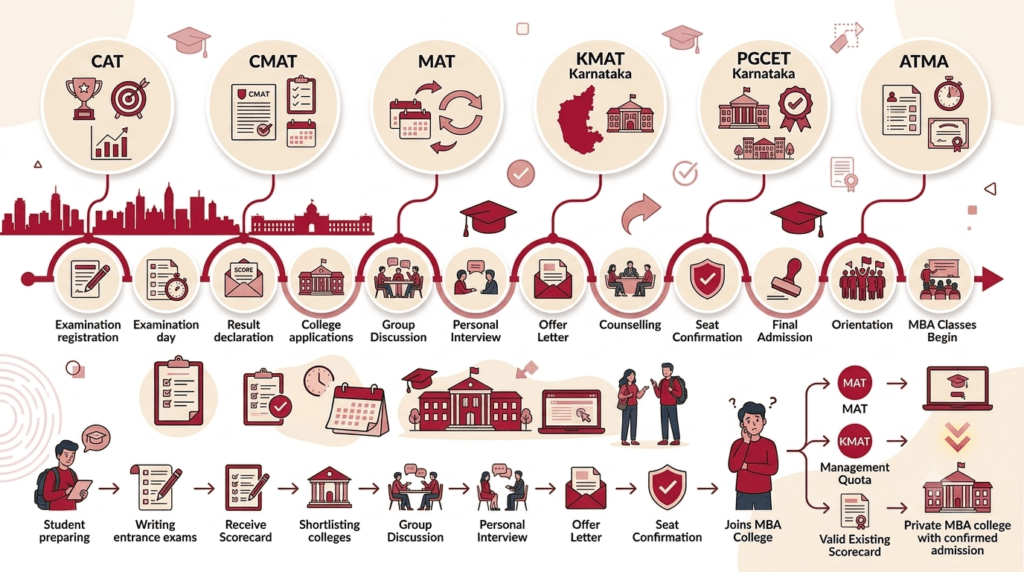
There are multiple exams and multiple college choices for MBA admission in Bangalore. Take a look at this consolidated data and decide which exam is right for you-
| Event | 2026 Date or Window | Action Required |
| CMAT 2026 | January-February 2026 (closed) | Next cycle: CMAT 2027 in Jan-Feb 2027 |
| Private college applications open | November 2025 onwards (rolling) | Apply to 4-5 colleges with CMAT/MAT score |
| PGCET 2026 Exam | June 14, 2026 | Closed for 2026; next cycle April-May 2027 |
| PGCET 2026 Results | Late June 2026 | Check cetonline.karnataka.gov.in |
| MAT May 2026 (PBT) | May 31, 2026 | Registration closed; June CBT: June 14 |
| MAT September 2026 | September 2026 (exact date TBA) | Next available MAT window for 2026-27 batch |
| KMAT Karnataka (next session) | August-September 2026 (estimated) | Check Karnataka Private PG Colleges Assoc. |
| GD/PI at private colleges | February to June 2026 (rolling) | Book slot after shortlisting notification |
| Offer letters issued | April to July 2026 | Accept within 7-15 days to hold seat |
| PGCET Counselling | July to August 2026 | Register on KEA portal; fill choices carefully |
| MBA batch start (Bangalore) | July or August 2026 | Confirm exact date with the college at offer stage |
The practical implication for students reading this in mid-2026: PGCET and CMAT have closed for the 2026 batch. MAT September, KMAT, and management quota routes are the remaining viable options for securing MBA admission in Bangalore for the current academic cycle.
If you have a low PGCET score or missed the exam, you can still apply for MBA admission. You can take admission through MAT, KMAT, management quota, or a valid entrance exam score.
Choosing the ideal management college is as important as getting it. Before finalising an MBA college in Bangalore, check ROI, accreditation, placement data, and the type of specializations each institute offers.
1. Accreditation- Verify NAAC accreditation on naac.gov.in and AICTE approval on aicte-india.org before accepting any offer. Grades expire. A college that shows ‘A grade’ in their brochure may be working from a lapsed accreditation. This verification takes 5 minutes and should be non-negotiable before any fee payment.
2. Placement– Always prioritize the median salary instead of high-flying averages, as it gives a truer picture of a typical graduate’s earnings. Furthermore, carefully verify the exact number of students placed out of the total batch, the source of the job (campus vs. networking), and which firms hired for your target specialization.
3. Specialization Depth vs General MBA- A college that offers deep specialization in Business Analytics or Finance with dedicated industry connections in those sectors will typically produce better placements in those specific fields than a college offering a broad general management curriculum. Match the college’s specialization strengths to your career direction.
For a breakdown of which specializations are in highest demand in Bangalore and what each career path looks like, read the guide on top MBA specializations in demand in 2026.
4. ROI- Total programme cost divided by expected annual take-home salary gives you the payback period. A college with Rs. 8 Lakh fees and Rs. 8 LPA average CTC recovers the investment in 12 to 14 months. A college with Rs. 18 Lakh fees and Rs. 12 LPA average CTC takes 18 to 22 months. The cheaper option is not always the better financial decision if the placement outcomes are proportionally weaker.
MBA admission is not limited to one process. Students can apply through PGCET, use CMAT or MAT scores for private colleges, or choose the management quota if they could not appear for an entrance exam. Each option has a separate admission process.
The best admission decisions usually come from good planning. Comparing placements and ROI for different colleges and applying accordingly, preparing for GD and PI rounds can help students choose the right MBA college.
If you are evaluating RCMB as part of your MBA admission shortlist for Bangalore, visit the RCMB MBA admission page or the RCMB PGDM admission page for programme details, or apply directly at rcmb.in/apply.
MBA Admissions are split into the government quota route using the PGCET and the autonomous route using national tests. After entrance exams, private colleges conduct selection rounds( like GD, PI, and WAT) for shortlisting candidates.
Most private MBA colleges in Bangalore gladly accept scores of entrance tests like MAT, CMAT, XAT, or KMAT Karnataka alongside CAT. You can apply to these colleges through direct management quota seats.
No, PGCET exam is not mandatory. PGCET is required if you are applying for government quota or taking admission in university affiliated and state- run MBA colleges.
The best time for premier two-year MBA programs using CAT scores is Round 1, between August and October. If you are applying for executive programs via GMAT/GRE, you can shoot for Round 1 deadlines in August and September. For private colleges, the ideal window to submit your application is between September and December for cycle 1 admission.
Management quota in MBA colleges reserves around 10-25% seats that private institutions fill directly. These seats do not require a minimum entrance cutoff score but cost 2 to 4 times more in tuition.