
MBA Without CAT in Bangalore 2026: Exams, Colleges and Admission Guide

 By Jai
MBA hiring in Bangalore in 2026 is being driven by three structural shifts: the GCC (Global Capability Centre) expansion across North and Central Bangalore, the FinTech corridor’s accelerating demand for Finance and Analytics MBAs, and a company-wide move toward skills-verified hiring over pedigree-based selection. Sectors hiring the most are IT and consulting, BFSI and FinTech, supply chain and logistics, and healthcare management. Mid-tier Bangalore MBA graduates are securing Rs. 7 to Rs. 12 LPA at fresher level, with specialization premiums pushing Analytics and FinTech Finance graduates toward the higher end.

Bangalore’s MBA job market in 2026 is not doing what most people expected two years ago. After the 2022-23 startup funding correction, many assumed that MBA hiring in the city would soften. Instead, it’s structurally diversified. The over-dependence on a single sector (IT services) has given way to a broader recruiter base that’s arguably more stable and better paying for mid-tier graduates.
According to AICTE’s management education data, India produced over 3.6 lakh MBA and PGDM graduates in the 2024-25 academic year. In Bangalore specifically, the concentration of companies per square kilometre of commercial space is the highest of any Indian city, which means campus recruitment reach and internship access are structurally stronger here than anywhere else.
Five trends are shaping MBA hiring in Bangalore in 2026 specifically:
Students often compare MBA placement outcomes across Bangalore, Hyderabad, Pune, and Delhi-NCR as if they’re equivalent markets. They’re not. Bangalore’s MBA hiring market has three structural characteristics that no other Indian city matches simultaneously.
First, Bangalore accounts for more than 35% of India’s IT exports and hosts approximately 40% of the country’s GCCs, according to NASSCOM’s technology sector report. This concentration means that the companies visiting Bangalore MBA campuses are operating at a different scale and with a different mandate than those visiting campuses in other cities.
| Factor | Bangalore | Hyderabad | Pune | Delhi-NCR |
| GCC density | Highest in India | Second highest | Moderate | Moderate |
| FinTech startup cluster | Koramangala-HSR (world-class density) | Limited | Moderate | Moderate |
| IT services recruiter base | Infosys, TCS, Wipro, Capgemini, Accenture all have major campuses | Strong but narrower | TCS, Infosys dominant | Services + BPO mix |
| BFSI recruiter presence | HDFC Bank, ICICI, PhonePe, Razorpay, Axis Bank | HDB, IIFL, Telangana banks | HDFC, ICICI moderate | PSU banks + NBFC dominant |
| Supply chain and logistics | Amazon, DHL, Delhivery, Blue Dart (North Bangalore corridor) | Warehousing dominated | Manufacturing logistics | E-commerce logistics |
| Healthcare hiring | Manipal, Apollo, Narayana present | Equally strong | Moderate | Hospitals + pharma |
The second structural difference is sector diversity. A Bangalore MBA graduate can realistically target IT consulting, BFSI, FinTech, e-commerce, supply chain, and healthcare in the same placement season. In Hyderabad, the recruiter pool tilts heavily toward IT and pharma. In Pune, manufacturing and IT dominate. In Delhi-NCR, FMCG and consulting are prominent but the financial services depth isn’t the same.
Third, Bangalore’s startup ecosystem, despite the 2022-23 funding correction, has stabilised at a higher base than most cities. Funded startups from the Blume, Sequoia, and Accel portfolios are back to steady MBA hiring in 2026, particularly for product, growth, and analytics roles.
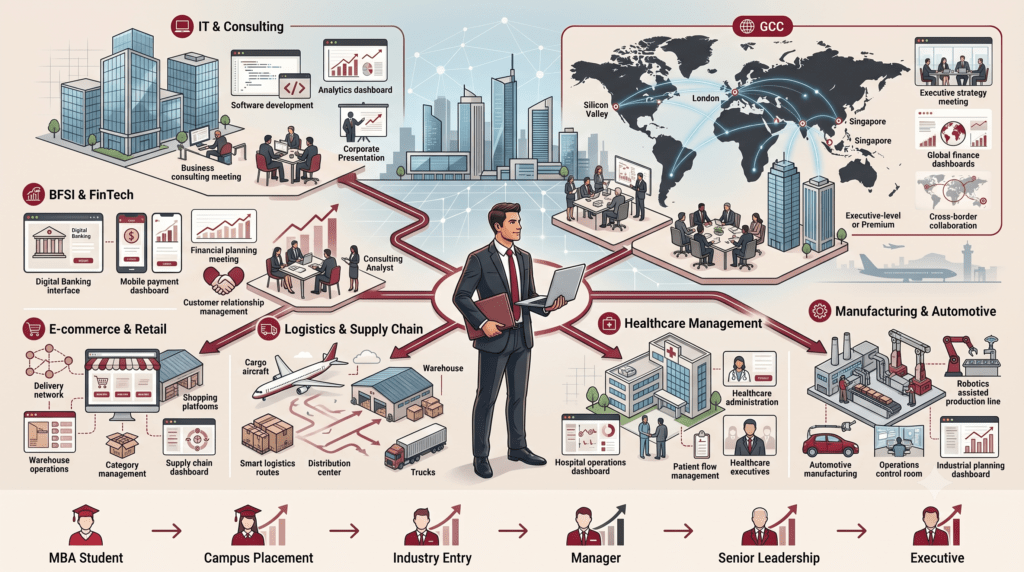
Here is the 2026 sector-by-sector picture, based on which companies are actively running campus recruitment programs and what kind of roles they’re hiring for.
| Sector | Bangalore Hiring Trend 2026 | Key Bangalore Recruiters | Roles MBA Graduates Enter | Hiring Momentum |
| IT and Consulting | Stable to growing; GCC layer added to traditional services | Accenture, TCS, Infosys, Capgemini, Cognizant, Wipro, IBM | Management Trainee, Business Analyst, Consulting Analyst | Strong and consistent |
| BFSI and FinTech | Fastest growing segment; FinTech outpacing traditional banking | HDFC Bank, ICICI Bank, PhonePe, Razorpay, Groww, BharatPe, Axis Bank | Relationship Manager, Risk Analyst, Product Manager, Growth Manager | Very high |
| Global Capability Centres (GCCs) | Emerging as the top-growth MBA recruiter category | Goldman Sachs, JP Morgan, HSBC, EY, KPMG, Deloitte, Amazon (tech) | Financial Analyst, Strategy Analyst, Risk Manager, Supply Chain Analyst | Highest growth rate |
| E-commerce and Retail | Stable; operations and analytics roles growing | Amazon, Flipkart, Meesho, Swiggy, Rapido | Category Manager, Operations Manager, Supply Chain Executive | Stable with analytics skew |
| Logistics and Supply Chain | Growing fast in North Bangalore corridor | Amazon Logistics, DHL, Delhivery, Blue Dart, Ecom Express | Logistics Manager, Demand Planner, Operations Lead | Growing; underserved by colleges |
| Healthcare Management | Underserved but growing; strong demand-supply gap | Manipal Hospitals, Apollo, Narayana Health, Medanta | Hospital Administrator, Healthcare Operations, Business Development | Rising but limited supply of trained MBAs |
| Manufacturing and Automobiles | Moderate; Hosur Road corridor active | Bosch, TVS Group, Minda, Sansera | Operations Manager, SCM Analyst, Plant HR | Consistent but selective |
The GCC column in this table is the most important development to track in 2026. Two years ago, Goldman Sachs’s Bangalore GCC, JP Morgan’s operations hub, and HSBC’s analytics centre were not significant MBA recruiters. That has changed. These centres have expanded their MBA hiring specifically because they’re being given more complex, higher-value work mandates from their global headquarters.
This is the most underreported MBA hiring story in Bangalore in 2026. GCCs, or Global Capability Centres, are captive units of multinational corporations that operate in India to deliver work that previously required being based in the company’s home market. They are not BPOs. They’re doing the actual work.
According to the India Brand Equity Foundation (IBEF), India now has over 1,750 GCCs employing more than 1.9 million people. Bangalore hosts approximately 40% of these, making it the single largest GCC destination in the country. In 2026, India’s GCC base is expected to grow further, with 300+ new centres announced or under construction.
What matters specifically for MBA students is what these GCCs are now doing. In 2020, a Bangalore GCC mostly handled back-office processing and IT support. In 2026, the mandate is completely different.
GCC roles typically pay 15 to 30% above the equivalent role at an Indian domestic company for the same profile. A financial analyst role at a Goldman Sachs GCC in Bangalore pays materially more than the equivalent role at an Indian private bank, while also offering global process exposure and a career pathway that can lead to rotations in London, New York, or Singapore.
The skill they’re hiring for is not just domain expertise. GCC recruiters consistently say they want MBA graduates who can work without close supervision on ambiguous, complex business problems. They don’t run the same case-framework interviews as consulting firms. They’re more likely to give you a real business dataset and ask you to make a decision.
The standard answer to this question hasn’t changed in a decade: communication skills, problem solving, teamwork, and cultural fit. That’s still true and still useless as preparation guidance. Here is what’s actually different in 2026 and specific to how Bangalore recruiters are evaluating candidates.
The World Economic Forum’s Future of Jobs Report 2025 identifies AI and big data literacy as the single highest-priority skill that employers plan to prioritise in the next three to five years. In Bangalore specifically, this plays out differently than in other cities. Recruiters at IT and GCC companies aren’t just checking whether you know what AI is. They want to see you use AI tools to solve a business problem during the interview.
A Pre-Placement Offer (PPO) is a job offer from your internship company, delivered before the formal campus placement season begins. In 2026, PPOs are not rare. They’re a strategy.
Companies like Amazon, PhonePe, Accenture, and TCS have significantly increased their PPO ratios from campus internship batches. Their stated reason: they want to lock in talent before the placement season, because the candidates they want are the same candidates other companies want. For a student, this means the internship is not a checkbox. It’s the actual placement opportunity.
This isn’t about which specialization earns the most, that’s a separate question with detailed answer. What this section covers is which specializations have the highest recruiter demand specifically in Bangalore’s 2026 market, where demand outstrips the supply of well-prepared candidates.
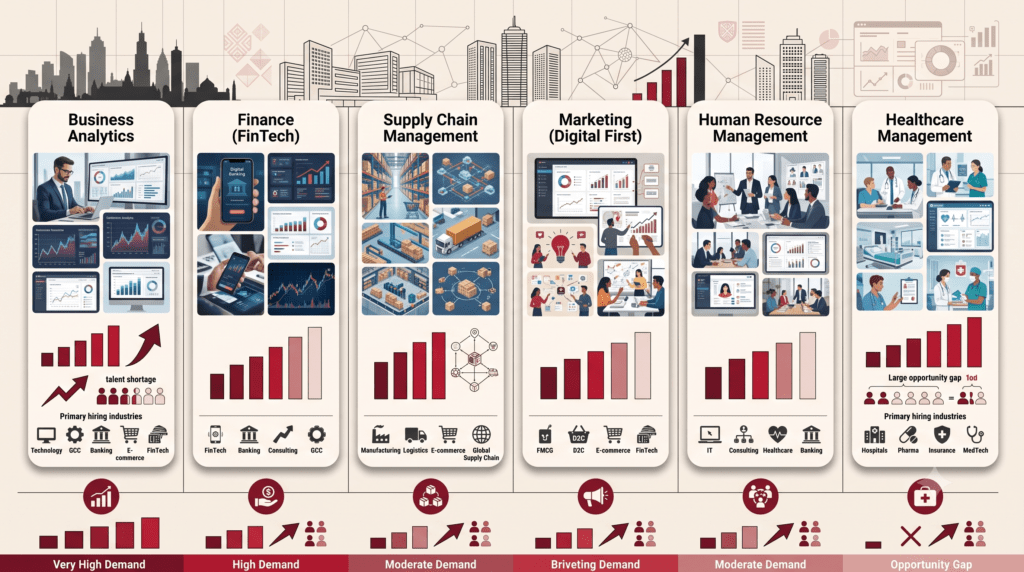
| Specialization | Bangalore Recruiter Demand 2026 | Demand vs Supply Gap | Primary Hiring Sectors |
| Business Analytics | Very high; most-mentioned in job postings | High gap: prepared candidates are scarce | IT, GCCs, E-commerce, BFSI, FinTech |
| Finance (FinTech-ready) | Very high; traditional Finance alone is less sought | High gap: FinTech-specific Finance skills are rare | FinTech, GCCs, BFSI, Consulting |
| Supply Chain Management | High and growing; North Bangalore logistics driving it | Medium gap: improving supply of candidates | E-commerce, Logistics, Manufacturing, GCCs |
| Marketing (Digital-first) | Moderate to high; digital marketing skills required | Medium gap: many graduates, fewer with real skills | E-commerce, D2C brands, FMCG, FinTech |
| Human Resource Management | Steady; HR analytics is the differentiator | Low gap: well-matched supply and demand | IT, Consulting, BFSI, Healthcare |
| Healthcare Management | High demand but very low supply | Very high gap: very few trained MBAs in this space | Hospitals, Insurance, Pharma, MedTech |
Healthcare Management stands out for one specific reason: the number of companies actively looking for MBA graduates in hospital administration and health-tech operations in Bangalore is growing, but the number of MBA graduates who specifically prepared for healthcare roles remains very small. That demand-supply gap translates to faster hiring and stronger negotiating position for the few well-prepared candidates.
For a full breakdown of how each specialization maps to career paths and long-term salary growth, read the detailed guide on which MBA specialization is best for your career in 2026.
The number you’ll see most often in Bangalore MBA college brochures is the highest package. Sometimes it’s the average. Almost never is it the median. And the batch size is usually missing from the same page.
This matters because the way most colleges present placement data makes their outcomes look better than they are for the typical student.
According to the NIRF Management Rankings 2024 from the Ministry of Education, graduation outcomes including median salary and placement percentage are now formal evaluation criteria for ranked institutions. This means NAAC-accredited colleges are increasingly under pressure to report these figures accurately rather than selectively.
For specific MBA salary benchmarks across sectors and experience levels in Bangalore, the guide on MBA salary in Bangalore covers fresher-level, 3-year, and 5-year salary data by specialization.
Students who prepared for MBA placements based on what they heard from seniors who graduated in 2022 or 2023 are showing up to a different interview than they expected. The campus recruitment process in Bangalore has changed in three meaningful ways.
The classic interview sequence was: HR round, then a case-study round using a framework, then an offer. That sequence is still present at some companies. At an increasing number of Bangalore recruiters, particularly GCCs, consulting arms of IT companies, and FinTech companies, it’s been replaced with something closer to this: here’s a real business question, here’s some data, you have 25 minutes, then explain your answer and defend it.
Amazon’s campus interview process in Bangalore now includes a situation-based round where candidates work through a supply chain or customer experience problem with actual constraints given in real time. PhonePe’s campus team has described their process as looking for how students think under uncertainty, not whether they know the ‘right’ answer.
Two years ago, the formal campus placement season at most Bangalore MBA colleges ran from January to March for the graduating batch. In 2026, several major companies are running Day 0 and Day 1 hiring processes in October and November, nearly six months earlier. This means students who haven’t committed to their target sector, role, and company list by September of their final year are already late.
The implication for Year 1 students is that specialization choice, internship targeting, and skill building need to start in the first semester, not after exam results are out.
The GD format is being used differently by different companies. IT services companies still use traditional GDs with a business or current affairs topic. GCC recruiters and FinTech companies are increasingly running case-based group discussions where all participants are given the same business scenario and asked to work through it as a team. The evaluation isn’t about who speaks most. It’s about whether the group moves toward a useful answer and whether individuals contribute to that process.
Students who treat the GD as a debate or as a performance opportunity consistently score lower in these formats than students who listen actively and build on what others have said.
Most career progression guides are too vague to be useful. ‘Year 1-2 entry level, Year 5-7 management level’ doesn’t tell you much. Here is the realistic Bangalore picture based on where MBA graduates from mid-tier Bangalore colleges are actually landing at each stage.
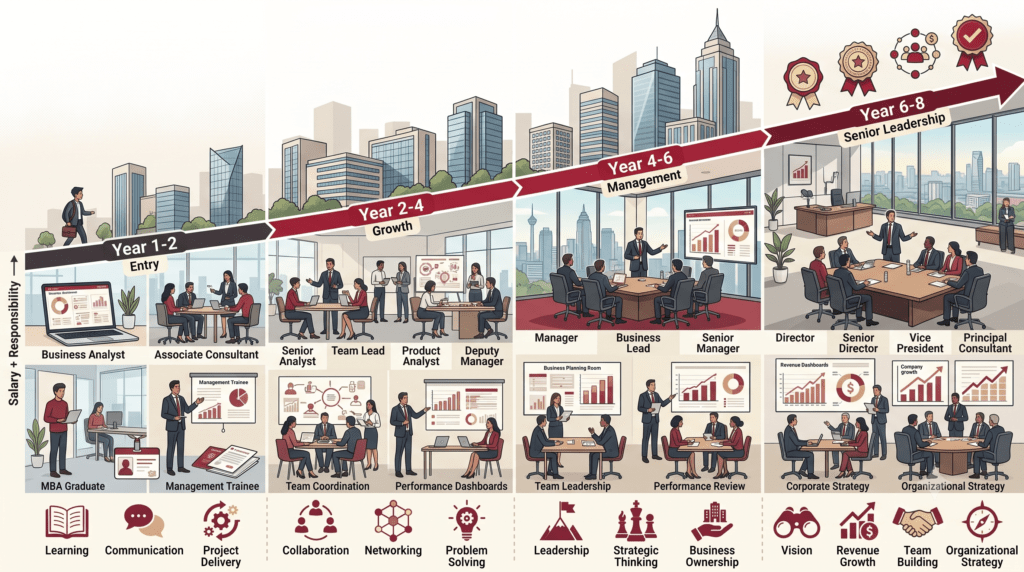
| Career Stage | Typical Roles at Bangalore Companies | Companies Where This Plays Out | Realistic CTC Range | What Moves You Forward |
| Year 1 to Year 2 (Fresher) | Management Trainee, Business Analyst, Associate Consultant, Relationship Manager | Accenture, TCS, HDFC Bank, PhonePe, Amazon, Capgemini | Rs. 7 to Rs. 12 LPA | Learning velocity, project ownership, performance in structured assessments |
| Year 2 to Year 4 (Junior Professional) | Senior Analyst, Team Lead, Deputy Manager, Product Analyst | Same companies; internal promotions; also lateral moves to GCCs | Rs. 12 to Rs. 20 LPA | Cross-functional exposure, measurable project outcomes, networking within the company |
| Year 4 to Year 6 (Mid-Level) | Manager, Business Lead, Senior Manager, Associate Director | GCCs (Goldman Sachs, JP Morgan, EY), BFSI (ICICI, Axis), E-commerce (Amazon, Flipkart) | Rs. 20 to Rs. 35 LPA | People management, P&L ownership experience, specialisation depth |
| Year 6 to Year 8 (Senior Leader) | Director, Senior Director, VP, Principal Consultant | GCCs, large IT consulting firms, BFSI head offices, startup leadership | Rs. 35 to Rs. 60 LPA and above | Track record on revenue or cost impact, team building, strategic scope |
The companies where you start matter less than you think at the Year 1 to Year 2 stage. What matters more is whether you’re getting a chance to own something, whether you’re being measured on an outcome rather than just attendance, and whether you’re working alongside people who are better than you in the skills you want to build.
The jump from Year 2 to Year 4 is where Bangalore’s ecosystem works in a student’s favour. The density of companies means that lateral moves between companies are very common and are rewarded with 30 to 40% salary jumps. A Bangalore MBA graduate who started at TCS and moves to a GCC role at Deloitte in Year 3 can close a significant compensation gap that would take 2 more years to close through normal increments at the same company.
These aren’t opinions. They’re patterns from multiple Bangalore placement seasons, told consistently by recruitment teams across different companies.
For guidance on how to evaluate whether a college’s placement support is strong enough to give you access to Bangalore’s top recruiters, read the guide on how to choose the right MBA college in Bangalore.
The hiring trends covered in this article are not hypothetical. Here is how RCMB’s 2024-25 placement season aligned with each of the major patterns described above.
| 2026 Hiring Trend | RCMB 2024-25 Placement Reality |
| IT and Consulting remains strongest MBA recruiter in Bangalore | Accenture, TCS, Capgemini, Cognizant, and Genpact all recruited from RCMB’s campus in 2024-25 |
| FinTech corridor driving Finance and Analytics hiring | PhonePe recruited from RCMB’s campus, a direct confirmation of the FinTech corridor trend |
| E-commerce driving Supply Chain and Operations hiring | Amazon and Flipkart both placed RCMB graduates in 2024-25 |
| BFSI remains active for Finance MBA graduates | HDFC Bank and ICICI Bank recruited from RCMB’s Finance and Analytics specializations |
| Mid-tier Bangalore colleges placing at Rs. 7-12 LPA fresher level | RCMB’s average CTC was Rs. 8.25 LPA with a 98.6% placement rate across both batches |
The 98.6% placement rate and Rs. 8.25 LPA average compare well against the mid-tier Bangalore benchmark. Sunstone reported Rs. 7.1 LPA for the top 25% of their students nationally. RCMB’s full batch average in Bangalore outperforms that benchmark.
For a full side-by-side comparison of RCMB against other Bangalore MBA colleges on placement, ROI, fees, and accreditation, read the guide on which college is best for MBA in Bangalore. To explore RCMB’s MBA and PGDM programmes, visit the RCMB programmes page.
Bangalore’s MBA hiring market in 2026 is stronger, more diverse, and more demanding than it was three years ago. The GCC boom has created a tier of hiring that didn’t meaningfully exist before. The FinTech corridor is outpacing traditional BFSI in terms of package growth. The North Bangalore logistics corridor is an underappreciated but real hiring opportunity for Supply Chain graduates.
The students who will get the best outcomes from this market are not necessarily the ones with the highest entrance exam scores. They’re the ones who chose a specialisation with genuine demand behind it, treated their internship as the placement opportunity it is, prepared for live problem solving rather than case frameworks, and applied to companies with a clear, specific reason for wanting to work there. These outcomes also depend on choosing the right MBA college in Bangalore with strong industry connections.
If you’re evaluating where to pursue your MBA to access this Bangalore hiring market, the guide on how to choose the right MBA college in Bangalore covers the specific factors that determine which colleges have real recruiter relationships and which ones claim them. You can also explore RCMB’s MBA programme and PGDM programme or apply directly at rcmb.in/apply.
For sector diversity, yes. Bangalore’s combination of IT, FinTech, GCCs, e-commerce, logistics, and healthcare creates a recruiter base that no other Indian city matches simultaneously. Hyderabad has strong IT and pharma but limited FinTech depth. Pune has strong manufacturing and IT but a smaller startup and GCC ecosystem. The comparison is closest when you compare total mid-tier salary outcomes, where Bangalore consistently edges out both cities for Finance, Analytics, and Consulting specializations.
Generally, yes, by 15 to 30% for comparable profiles. A financial analyst role at a Goldman Sachs GCC pays materially more than a similar analyst role at an IT services company doing BFSI work. The premium reflects the complexity of the mandate and the global process exposure. However, GCC roles are also more selective. The interview process is more demanding and the shortlisting criteria tighter, which is why only a proportion of MBA students access these roles in any given placement season.
Yes, meaningfully, especially at GCCs and consulting firms. Students with 2 to 4 years of relevant work experience before their MBA consistently receive 10 to 25% higher initial offers at companies like Accenture, Deloitte, and JP Morgan’s Bangalore operations. The reason is that these companies can give experienced hires more senior mandates immediately rather than investing in a 6 to 12 month onboarding period. For students without work experience, the internship quality becomes the substitute signal.
Historically 3 to 4 months, from December to March for a graduating batch. In 2026, the effective placement window has extended both ends. Day 0 hiring by top companies now runs in October and November, while smaller and sector-specific companies continue to recruit through May and June. Students who are not placed in the first wave have more options than they often realise, because the second and third waves include a growing number of GCCs and mid-market companies that prefer less crowded recruitment windows.
Directly from campus, this is rare but growing through GCC hiring. The indirect path is more common: a mid-tier Bangalore MBA graduate joins a GCC (Goldman Sachs Bangalore, KPMG India, Amazon Bangalore) and within 3 to 5 years is eligible for global rotation opportunities. Several Bangalore-based GCCs have formal rotation programs to their home markets. RCMB graduates at companies like Accenture and Capgemini have accessed these pathways through internal mobility programs.
Based on current economic signals, 2027 looks stable to improving. The GCC expansion trajectory is expected to continue, with 300+ new GCCs announced or under construction in India. FinTech hiring in Bangalore is tied to digital payment volumes, which are growing at 40%+ year-on-year. The one variable is IT services hiring, which has been flat in 2026 and may remain so in 2027 as automation replaces some entry-level IT roles. The net effect is a reshuffling toward analytics, strategy, and domain-specialised MBA roles rather than a contraction overall.
The North Bangalore corridor from Devanahalli through Hebbal to Manyata Tech Park is particularly active for Supply Chain and Operations MBA hiring. Amazon’s logistics and tech operations near the airport, DHL’s Bangalore distribution hub, Delhivery’s operations centre, and Blue Dart’s South India headquarters are all in or near this corridor. Additionally, aerospace companies near HAL (Hindustan Aeronautics) and several manufacturing units on the Hosur Road extension are hiring for Supply Chain and Operations roles. RCMB’s Devanahalli campus sits inside this hiring zone, which is a structural campus recruitment advantage.
There’s no publicly available industry-wide figure for this, but placement teams at mid-tier Bangalore colleges consistently report that 15 to 35% of placed students receive PPOs from internship companies, with the figure trending higher each year as companies embed the PPO strategy into their campus hiring budgets. At RCMB specifically, the internship-to-PPO pipeline has been growing year on year. Students who receive PPOs also tend to receive higher packages than batch average, because the offer is made for a specific individual rather than a generic fresher profile.